Many custom options...


And formats...



Tai Chi Chuan Tai Ji Quan in Chinese / Japanese...
Buy a Tai Chi Chuan Tai Ji Quan calligraphy wall scroll here!
Personalize your custom “Tai Chi Chuan Tai Ji Quan” project by clicking the button next to your favorite “Tai Chi Chuan Tai Ji Quan” title below...
1. Shaolin Chuan / Shao Lin Quan
2. Kenpo / Kempo / Quan Fa / Chuan Fa
3. Tai Chi Chuan / Tai Ji Quan
4. Tai Chi Chuan Dao / Tai Ji Quan Dao
5. Tai Chi Chuan Fa / Tai Ji Quan Fa
6. Ba Ji Quan
7. Xing Yi Quan
9. Iron Fist
10. Taekwondo
Shaolin Chuan / Shao Lin Quan
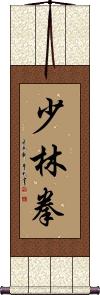
少林拳 is the title of the martial art (style of Kung Fu) that is taught to the monks and students in the Shaolin Buddhist Monastery.
The addition of Chuan or Quan, which means fist is what signifies that you are talking about this school or form of martial arts.
Kenpo / Kempo / Quan Fa / Chuan Fa
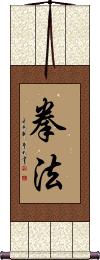
拳法 is a form of martial arts that can be translated in several ways.
Some will call it “fist principles,” “the way of the fist,” or even “law of the fist.” The first character literally means fist. The second can mean law, method, way, principle, or Buddhist teaching.
Kempo is really a potluck of martial arts. Often a combination of Chinese martial arts such as Shaolin Kung Fu with Japanese martial arts such as Karate, Jujutsu (Jujitsu), Aikido, and others. You may see the term “Kempo Karate,” which basically means Karate with other disciplines added. In this way, Kempo becomes an adjective rather than a title or school of martial arts.
These facts will long be argued by various masters and students of Kempo. Even the argument as to whether it should be spelled “kenpo” or “Kempo” ensues at dojos around the world (the correct Romaji should actually be “kenpou” if you precisely follow the rules).
The benefit of Kempo is that the techniques are easier to learn and master than pure Kung Fu (wu shu). Students are often taught basic Karate moves, kicks, and punches before augmenting the basic skills with complex Kung Fu techniques. This allows students of Kempo to achieve a level where they can defend themselves or fight in a relatively short amount of time (a few years rather than a decade or more).
Because the definition of this word is so fluid, I should make some notes here:
1. Purists in Okinawa will claim that “Okinawa Kenpo” or “Ryukyu Hon Kenpo” is the original and true version of this martial art from the old kingdom. It is actually little or no connection between Okinawa Kenpo and the way the word is used elsewhere.
2. In Chinese, where these characters are pronounced “quan fa” (sometimes Romanized as “chuan fa” because the Chinese-pinyin “q” actually sounds like an English “ch” sound), these characters do not hold the connotation of being a mixed martial art. It is simply defined as “the law of the fist.”
3. My Japanese dictionary oddly defines Kenpo as the “Chinese art of self-defense.” I personally don't feel this is the most common way that people perceive the word but just something you should know.
Tai Chi Chuan / Tai Ji Quan
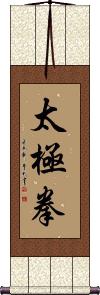
太極拳 is the famous Taoist meditation and martial art exercise. The direct translation of these characters would be something like “grand ultimate fist,” but that does not quite hit the mark for what this title really means.
An early-morning walk through any city in China near a park or an open area will yield a view of Chinese people practicing this ancient technique.
A typical scene is an old man of no less than 80 years on this earth, with a wispy white beard and perhaps a sword in one hand. He makes slow moves that are impossibly smooth. He is steady-footed and always in balance. For him, time is meaningless and proper form, and technique is far more important than speed.
For the younger generation, faster moves may look impressive and seem smooth to the casual observer. But more discipline and mental strength are needed to create perfectly smooth moves in virtual slow motion.
Note: There are two ways to Romanize these Chinese characters, as seen in the title above. The pronunciation and actual characters are the same in Chinese. If you really used English sounds/words to pronounce this, it would be something like “tie jee chew-on” (make the “chew-on” one flowing syllable).
Tai Chi Chuan Dao / Tai Ji Quan Dao
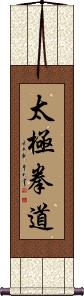
太極拳道 is the common Tai Chi Chuan title with “Dao” (the Way) added to the end.
If you're not sure, I suggest shorter titles such as “Tai Chi Chuan,” or just “Tai Chi.”
Tai Chi Chuan Fa / Tai Ji Quan Fa
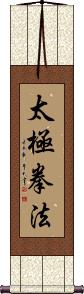
太极拳法 literally translates as “Tai Chi Fist Law” though 拳法 is also known in Japanese as “Kempo” which is sometimes read as “boxing” depending on context.
Ba Ji Quan
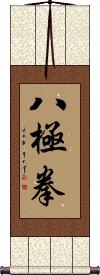
八極拳 is “Ba Ji Quan” or “Eight Extremes Fist.”
Some also translate this as “Eight Extremities Fist,” though I don't feel that's accurate.
八極拳 (Bājíquán) is a Chinese martial art that features explosive, short-range power and is famous for its elbow strikes. It originated in the Hebei Province in Northern China but spread to Taiwan and other places.
The full title is 開門八極拳 (Kāimén Bājíquán), which means Open-Door Bajiquan.
Other romanizations include: BaJiQuan, Pa Chi Ch`üan, or Pa Chi Chuan.
In Japan, this is known as Hakkyokuken.
Xing Yi Quan
Style of Martial Arts
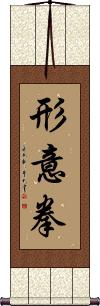
形意拳 is the title for the Xingyiquan style/form of Chinese martial arts involving explosive linear movements.
Some translate this as “shape-of-the-mind fist.”
While pronunciation has never changed in Chinese, the old romanization was “Hsing I Chuan.” This romanization for 形意拳 is still used in Taiwan.
This term is used in some Japanese martial arts circles where it's romanized from Japanese as keīken, keiiken, or keiken.
Tai Chi / Tai Ji
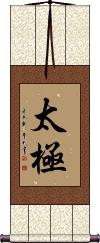
太極 is the shortened title for Tai Chi Chuan or Tai Ji Quan that is sometimes used in Western countries.
Basically just removing the last character which means fist. I don't recommend this two-character selection because it's not really a word without the third character in Japanese and Chinese.
Iron Fist
Tie Quan / Tieh Chuan
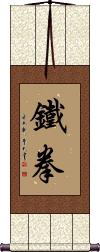
鐵拳 is a common theme used by various schools of martial arts.
鐵 means “iron” but, in some cases, can mean “indisputable.”
拳 means fist.
Some schools use the older/Taiwanese way to Romanize the iron fist, so you may have seen it spelled “Tieh Chuan” instead of “Tie Quan.” Neither way is technically incorrect.
Note that in Mandarin, the first part of the first character sounds like the English word “tea,” blending into a soft “-eh” sound. The second character sounds a lot like “chew on” but as if it is one syllable.
 After WWII in Japan, the Kanji for iron was simplified. This new Kanji form is shown to the right. If you want this modern Japanese version, please click on the Kanji to the right, instead of the button above. The characters shown to the left would still be considered the old or ancient Japanese version of this title.
Taekwondo
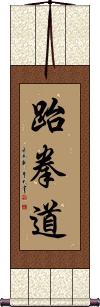
跆拳道 is one of the most widespread types of martial arts in the world as well as being an Olympic sport. Taekwondo was born in Korea with influences of Chinese and Japanese styles combined with traditional Korean combat skills. Some will define it as the “Korean art of empty-handed self-defense.”
In the simplest translation, the first character means “kick,” the second character can mean either “fist” or “punching,” and the third means “way” or “method.” Altogether, you could say this is the “Kick Punch Method.” When heard or read in various Asian languages, all will automatically think of this famous Korean martial art. It is written the same in Japanese Kanji, Chinese, and Korean Hanja characters - so the appearance of the characters is universal. However, you should note that there is another way to write this in modern Korean Hangul characters, which looks like the image to the right. 
We suggest the original Korean Hanja (Chinese characters) for a wall scroll, but if you need the Hangul version, you must use master calligrapher Cao Bin: Order Taekwondo in Korean Hangul
Note: Taekwondo is sometimes Romanized as Tae-Kwondo, Tae Kwon Do, Taekwon-do, Taegwondo, Tae Gweon Do, Tai Kwon Do, Taikwondo, Taekwando, Tae Kwan Do and in Chinese Taiquandao, Tai Quan Dao, Taichuando, or Tai Chuan Tao.
Fatal error: Cannot redeclare foreignPrice() (previously declared in /home/gwest/web/chinesescrollpainting.com/public_html/includes/currencyconverter.php:22) in /home/gwest/web/orientaloutpost.com/public_html/includes/currencyconverter.php on line 22