Many custom options...


And formats...



Ten Commandments in Chinese / Japanese...
Buy a Ten Commandments calligraphy wall scroll here!
Personalize your custom “Ten Commandments” project by clicking the button next to your favorite “Ten Commandments” title below...
Ten Commandments
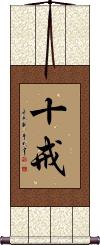
十戒 means Ten Commandments or Ten Precepts.
In the Buddhist context, these are prohibitions consisting of five commandments for the layman:
1. Not to destroy life 不殺生 Pāṇātipātāveramaṇi.
2. Not to steal 不倫盜 Adinnādānāver.
3. Not to commit adultery 不婬慾 Abrahmacaryaver.
4. Not to lie 不妄語 Musāvādāver.
5. Not to take intoxicating liquor 不飮酒 Suramereyya-Majjapamādaṭṭhānāver.
The ten commandments for the monk are the preceding five plus:
6. Not to eat food outside of regulated hours 不非時食 Vikāla-Bhojanāver.
7. Not to use garlands or perfumes 不著華鬘好香塗身 Mālā- Gandha-Vilepana-Dhāraṇa-Maṇḍana-Vibhūṣanaṭṭhānā.
8. Not to sleep on high or broad beds (chastity) 不坐高廣大牀 Uccāsayanā-Mahāsayanā.
9. Not to take part in singing, dancing, musical or theatrical performances 不歌舞倡伎不往觀聽 Nacca-Gīta-Vādita-Visūkadassanāver.
10. To refrain from acquiring uncoined or coined gold, or silver, or jewels 不得捉錢金銀寶物 Jātarūpa-Rajata-Paṭīggahaṇāver.
These original Buddhist commandments date back to about 2500 years ago. The English definitions above are followed by Chinese characters and original Pali pronunciation.
Under the Māhayāna Buddhism, these ten commands for the monk were changed, to accord with the new environment of the monk, to the following: not to kill, not to steal, to avoid all unchastity, not to lie, not to slander, not to insult, not to chatter, not to covet, not to give way to anger, to harbor no skepticism.
Five Precepts
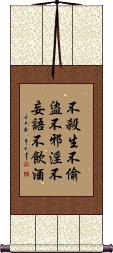
不殺生不偷盜不邪淫不妄語不飲酒 is the full list of the five precepts of Buddhism in Chinese.
There are many ways to translate or express these.
The following is one basic way:
1. Do not kill/murder.
2. Do not steal.
3. Do not commit adultery and/or sexual misconduct.
4. Do not lie or speak falsehoods.
5. Do not become intoxicated (with drugs/alcohol).
Here is another take from my favorite magazine: Lion's Roar: Five Precepts
Five Precepts
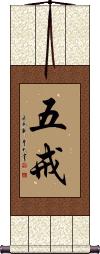
五戒 is the title or name for the five precepts of Buddhism.
These are prohibitions against killing, theft, sexual misconduct, lying, and intoxication.
Also phrased as commandments against murder, stealing, adultery, false speech, and consuming intoxicating liquors.
These five precepts or “pañca-veramaṇī” apply to the Buddhist laity as well as monks and nuns. The observance of these five ensures rebirth in the human realm.
John 14:15
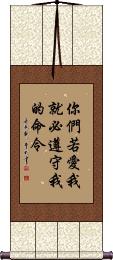
你們若愛我就必遵守我的命令 is the translation of John 14:15 into Chinese.
This comes from the Chinese Union Bible which comes from a revised King James version. This Chinese Bible was originally translated and printed in 1919 (several revisions since then).
Because of the origin being the KJV, I'll say that in English, this would be, “If ye love me, keep my commandments...”
In basic English, this would be, “If you have love for me, you will keep my laws.”
Fatal error: Cannot redeclare foreignPrice() (previously declared in /home/gwest/web/chinesescrollpainting.com/public_html/includes/currencyconverter.php:22) in /home/gwest/web/orientaloutpost.com/public_html/includes/currencyconverter.php on line 22