Many custom options...


And formats...



The Dao of Filial Piety in Chinese / Japanese...
Buy a The Dao of Filial Piety calligraphy wall scroll here!
Personalize your custom “The Dao of Filial Piety” project by clicking the button next to your favorite “The Dao of Filial Piety” title below...
The Dao of Filial Piety
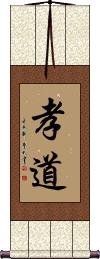
孝道 most clearly expresses the Confucian philosophy of filial piety.
Confucius taught that all should be respectful and obedient to their parents. Included in this idea is honoring your ancestors.
The second character is “dao/tao” or “the way” as in Taoism. You can say this title is “The Tao of Filial Piety” or “The Way of Filial Piety.”
See Also: Confucius
Filial Piety / Filial Conduct
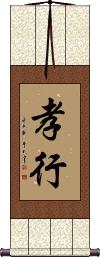
孝行 expresses the idea of filial piety or filial conduct.
While the first character means filial piety by itself, the second character adds “action.” Therefore this represents the actions you take to show your respect and obedience to your elders or ancestors.
Confucius is probably the first great advocate for filial piety.
Filial Piety
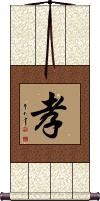
孝 represents filial piety.
Some will define this in more common English as “respect for your parents and ancestors.”
孝 is a subject deeply emphasized by the ancient philosophy and teachings of Confucius.
Some have included this in the list for the Bushido, although generally not considered part of the 7 core virtues of the warrior.
Note: 孝 is not the best of meanings when seen as a single character. Some will read the single-character form to mean “missing my dead ancestors.” However, when written as part of Confucian tenets, or in the two-character word that means filial piety, the meaning is better or read differently (context is important for this character).
We suggest one of our other two-character filial piety entries instead of this one.
Honor for Ancestors
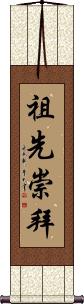
祖先崇拜 means “Appreciation and honor of your ancestors.”
This can refer to anyone from your grandparents and beyond.
The first two characters mean ancestors or forefathers.
The last two characters mean worship, adore/adoration, or admiration.
This is the kind of wall scroll that a filial son or daughter in China or Japan would hang to honor their ancestors who paved the way for the new generation.
 Japanese use a slight variation on the last Kanji. If you want this specifically Japanese version, just click on the Kanji image to the right (instead of the button above). Note that Japanese people would easily be able to identify the original Chinese form of that Kanji anyway.
They also have a similar phrase in old Korean but the first two characters are reversed - just let me know if you want that version when you place your order.
Koushinkan / Koshinkan

孝心館 is the title for Koushinkan, Koshinkan, or Kōshin-Kan.
The romanization of this title varies a little, but the original characters are the same.
孝 = Filial piety or obedience.
心 = Heart, mind, intention, or center.
馆 = Building or establishment (dojo).
This can be pronounced in Chinese and has the same meaning, but you should consider this a Japanese martial arts title.
Fatal error: Cannot redeclare foreignPrice() (previously declared in /home/gwest/web/chinesescrollpainting.com/public_html/includes/currencyconverter.php:22) in /home/gwest/web/orientaloutpost.com/public_html/includes/currencyconverter.php on line 22