Many custom options...


And formats...



The Original Mind in Chinese / Japanese...
Buy a The Original Mind calligraphy wall scroll here!
Personalize your custom “The Original Mind” project by clicking the button next to your favorite “The Original Mind” title below...
The Original Mind
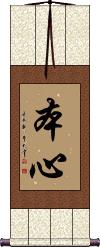
In Zen Buddhism, 本心 means “original mind” or “original heart,” which refers to one's Buddha-nature present from birth.
This can also be translated as true feelings, real intention, one's own heart, one's right mind, one's senses, one's conscience, or fundamental mind.
Note: 心 can mean heart or mind - thought in ancient Asia to be the same organ.
Mind of the Beginner
Shoshin
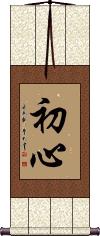
初心 is often translated in Japanese as “beginner's mind” or “beginner's spirit.”
In Chinese, the dictionary definition is “one's original intention.”
The first character means first, initial, primary, junior, beginning, or basic.
The second character means heart, mind, soul, or essence.
初心 is one of the five spirits of the warrior (budo) and is often used as a Japanese martial arts tenet. Under that context, places such as the Budo Dojo define it this way: The state of shoshin is that of a beginners mind. It is a state of awareness that always remains fully conscious, aware, and prepared to see things for the first time. The attitude of shoshin is essential to continued learning.
Open Mind
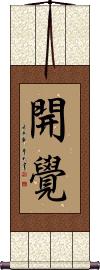
開覺 is a Buddhist term meaning “open mind.”
The more full definition as used in Buddhism is, “To arouse, awaken; to allow the original Buddha-nature to open and enlighten the mind.”
No Mind / Mushin
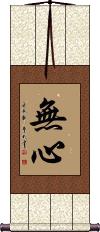
In Japanese, 無心 means innocent or without knowledge of good and evil. It literally means “without mind.”
無心 is one of the five spirits of the warrior (budo) and is often used as a Japanese martial arts tenet. Under that context, places such as the Budo Dojo define it this way: “No mind, a mind without ego. A mind like a mirror which reflects and dos not judge.” The original term was “mushin no shin,” meaning “mind of no mind.” It is a state of mind without fear, anger, or anxiety. Mushin is often described by the phrase “Mizu no Kokoro,” which means “mind like water.” The phrase is a metaphor describing the pond that clearly reflects its surroundings when calm but whose images are obscured once a pebble is dropped into its waters.
This has a good meaning in conjunction with Chan / Zen Buddhism in Japan. However, out of that context, it means mindlessness or absent-mindedness. To non-Buddhists in China, this is associated with doing something without thinking.
In Korean, this usually means indifference.
Use caution and know your audience before ordering this selection.
More info: Wikipedia: Mushin
Luo / Raku
Surname
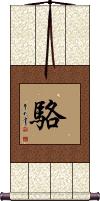
駱 is a character that can be a Chinese surname Luo or a Japanese surname Raku.
The original meaning of this character is a camel, but that is rather archaic. The surname is the first thing that comes to mind for any Chinese or Japanese person.
Koushinkan / Koshinkan

孝心館 is the title for Koushinkan, Koshinkan, or Kōshin-Kan.
The romanization of this title varies a little, but the original characters are the same.
孝 = Filial piety or obedience.
心 = Heart, mind, intention, or center.
馆 = Building or establishment (dojo).
This can be pronounced in Chinese and has the same meaning, but you should consider this a Japanese martial arts title.
Seeing one’s Nature and becoming a Buddha
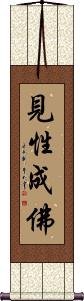
見性成佛 is a universal phrase that suggests that one may see one's nature and accomplish Buddhahood.
見性 suggests penetrating deep inside oneself to see one's “Original finally
Mind.”
成佛 refers to a sentient being who dispenses with illusions and delusions
through ascetic practice, is enlightened to the truth, and becomes a Buddha.
This is used by Mahayana, Chan, and Zen Buddhists in China, Korea, and Japan.
You will also see this with the last character written as 仏 in Japanese. In the religious context, 佛 is commonly used to mean Buddha. If you want the other version, see Kenshō Jōbutsu 見性成仏
Sanchin
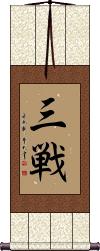
三戦 is a title that literally means “three battles/conflicts/wars.”
三戦 is often figuratively used to relay the idea of a battle to unify the mind, body, and spirit.
Original usage likely comes from Fujian province in Southern China (just across from Taiwan).
This title is used in various schools such as Okinawan Karate, Uechi-Ryū, Gōjū-Ryū, Fujian White Crane, and Five Ancestors among others.
Spirit / Spiritual Essence
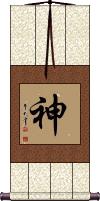
神 is the simplest way to write spirit in Chinese, Japanese Kanji, and old Korean.
This single character alone will conjure up ideas of the spiritual world. 神 can also be translated as “vital awareness” as in the fact that one must know they exist to exist (I think, therefore, I am).
Other translations include:
God, deity, mysterious, divine essence, lively, spiritual being, divinity, supernatural, soul, mind, nerves, and energy. In some extended context, it can mean genius or unusual.
Japanese romanizations vary a lot when this character is combined into other words. However, shin is the original pronunciation taken from Chinese into Japanese. You'll also see it romanized as kami, gami, jin, and a few others, depending on context.
Body and Earth in Unity
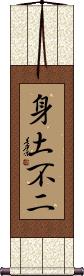
身土不二 (Shindofuni) is originally a Buddhist concept or proverb referring to the inseparability of body-mind and geographical circumstances.
This reads, “Body [and] earth [are] not two.”
Other translations or matching ideas include:
Body and land are one.
Body and earth can not be separated.
Body earth sensory curation.
You are what you eat.
Indivisibility of the body and the land (because the body is made from food and food is made from the land).
Going further, this speaks of our human bodies and the land from which we get our food being closely connected. This phrase is often used when talking about natural and organic vegetables coming directly from the farm to provide the healthiest foods in Japan.
Character notes: 身(shin) in this context does not just mean your physical body but a concept including both body and mind.
土 (do) refers to the soil, earth, clay, land, or in some cases, locality. It's not the proper name of Earth, the planet. However, it can refer to the land or realm we live in.
Japanese note: This has been used in Japan, on and off, since 1907 as a slogan for a governmental healthy eating campaign (usually pronounced as shindofuji instead of the original shindofuni in this context). It may have been hijacked from Buddhism for this propaganda purpose, but at least this is “healthy propaganda.”
Korean note: The phrase 身土不二 was in use by 1610 A.D. in Korea, where it can be found in an early medical journal.
In modern South Korea, it's written in Hangul as 신토불이. Korea used Chinese characters (same source as Japanese Kanji) as their only written standard form of the language until about a hundred years ago. Therefore, many Koreans will recognize this as a native phrase and concept.
See Also: Strength and Love in Unity
Zen Buddhism
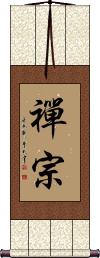
禪宗 is one way to title “Zen Buddhism.” Because the original pronunciation of Zen in Chinese is Chan, you'll also see this expressed as Chan Buddhism.
From the Buddhist Dictionary:
The Chan, meditative or intuitional, sect is usually said to have been established in China by Bodhidharma, the twenty-eighth patriarch, who brought the tradition of the Buddha-mind from India. This sect, believing in direct enlightenment, disregarded ritual and sūtras and depended upon the inner light and personal influence for the propagation of its tenets, founding itself on the esoteric tradition supposed to have been imparted to Kāśyapa by the Buddha, who indicated his meaning by plucking a flower without further explanation. Kāśyapa smiled in apprehension and is supposed to have passed on this mystic method to the patriarchs. The successor of Bodhidharma was 慧可 Huike, and he was succeeded by 僧璨 Sengcan, 道信 Daoxin, 弘忍 Hongren, 慧能 Huineng, and 神秀 Shenxiu, the sect dividing under the two latter into the southern and northern schools: the southern school became prominent, producing 南嶽 Nanyue and 靑原 Qingyuan, the former succeeded by 馬祖 Mazu, the latter by 石頭 Shitou. From Mazu's school arose the five later schools.
Fatal error: Cannot redeclare foreignPrice() (previously declared in /home/gwest/web/chinesescrollpainting.com/public_html/includes/currencyconverter.php:22) in /home/gwest/web/orientaloutpost.com/public_html/includes/currencyconverter.php on line 22