Many custom options...


And formats...



This Too Shall Pass in Chinese / Japanese...
Buy a This Too Shall Pass calligraphy wall scroll here!
Personalize your custom “This Too Shall Pass” project by clicking the button next to your favorite “This Too Shall Pass” title below...
2. Let It Be
5. Super
6. Smriti
7. Flowers Bloom and Flowers Fall
8. Flowers Bloom and Flowers Wither
9. Time and Tide Wait for No Man
10. Impermanence
This Too Shall Pass
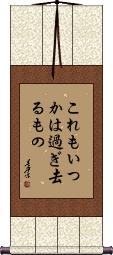
これもいつかは過ぎ去るもの means “this too shall pass,” in Japanese.
Note: Because this selection contains some special Japanese Hiragana characters, it should be written by a Japanese calligrapher.
This Too Shall Pass
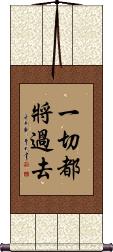
一切都將過去 is a phrase that means “this too shall pass” in Chinese.
This should be a reminder on your wall that no matter how bad things get, difficulties in life are transient and will go away in time.
This is not the only way to express this idea, as there are also 这一切都会过去 and 一切都会过去.
The version we are using here is more traditional sounding.
Let It Be
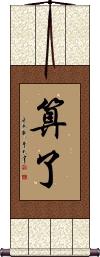
This Chinese word means “let it be,” “let it pass,” “let it go,” or “forget about it.”
Guan / Kwan / Seki
Surname
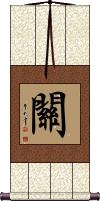
關 is a surname in three languages.
In Chinese, it romanizes as Guan.
In Korean, it's Kwan (or Gwan).
In Japanese it's Seki.
The meaning of the character is mountain pass; to close; to shut; to turn off; barrier; frontier.
Tetsu / Penetrating
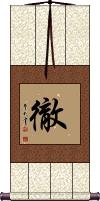
徹 is commonly used in Japan as a given name, romanized as Tetsu.
The meaning of this Kanji is: thorough; penetrating; to pervade; to pass through; pervious; perspicacious; throughout; communal.
徹 can also be romanized as Michi; Tooru; Touru; Tetsuji; Tsuyoshi; Choru; Osamu; Itaru; or Akira.
Super
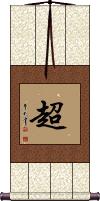
超 is “super” in Chinese and Japanese Kanji.
It can also mean: to exceed; to overtake; to surpass; to transcend; to pass; to cross; to jump over. It can also be a suffix like ultra- hyper- super-
From Sanskrit, this can be the Buddhist “vikrama,” meaning to leap over; surpass; exempt from; to save.
Smriti
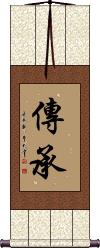
傳承 is a Chinese and Japanese word that means to pass on (to future generations).
This can also mean passed on (from former times), a continued tradition, handing down (information), legend, tradition, folklore, transmission, or an inheritance.
傳承 is the Chinese equivalent of Smriti (from Sanskrit: स्मृति / Smṛti). The term can be used for Hindu (and sometimes Buddhist) texts that have authority because the author is known.
Flowers Bloom and Flowers Fall
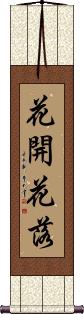
花開花落 is a complete proverb that lightly speaks of the cycle of life, or how things come and go in life.
This is used as a metaphor to suggest that youth is a temporary state that in time will pass.
This can also be used to suggest that fortunes can come and go (everything is temporary).
Note: There are two very similar versions of this proverb. The other uses a word that means wither instead of fall.
Flowers Bloom and Flowers Wither
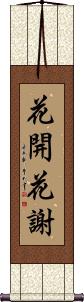
花開花謝 is a complete proverb that lightly speaks of the cycle of life, or how things come and go in life.
This is used as a metaphor to suggest that youth is a temporary state, which in time, will pass.
This proverb can be used to suggest that fortunes can come and go (everything is temporary).
Note: There are two very similar versions of this proverb. The other uses a word that means fall instead of wither.
Time and Tide Wait for No Man
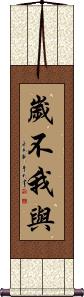
歲不我與 is a Chinese proverb that means is a way to express, “Time and tide wait for no man.”
The literal meaning of these Chinese characters is, “Years don't [for] oneself wait.” In more natural English, it's more like, “Years will pass by, with or without you.”
There is also an alternate version, 时不我待, which literally means “Time doesn't [for] oneself, wait.” In natural English, it's more like, “Time waits for no man.”
Impermanence
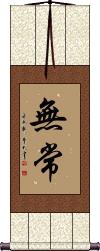
無常 is the state of being “not permanent,” “not enduring,” transitory, or evolving.
It can also mean variable or changeable. In some contexts, it can refer to a ghost that is supposed to take a soul upon death. Following that, this term can also mean to pass away or die.
In the Buddhist context, this is a reminder that everything in this world is ever-changing, and all circumstances of your life are temporary.
If you take the Buddhist philosophy further, none of these circumstances are real, and your existence is an illusion. Thus, the idea of the eternal soul is perhaps just your attachment to your ego. Once you release your attachment to all impermanent things, you will be on your way to enlightenment and Buddhahood.
Language notes for this word when used outside the context of Buddhism:
In Korean Hanja, this means uncertainty, transiency, mutability, or evanescent.
In Japanese, the definition orbits closer to the state of being uncertain.
The farts of others stink, but one’s own smells sweet
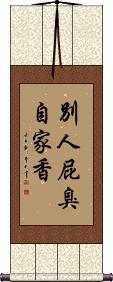
别人屁臭自家香 literally translates as:
Other people's flatulence stinks, [but] one's own is fragrant.
Figuratively, this means:
Some people criticize defects in others that they (seem to) treasure in themselves.
Fatal error: Cannot redeclare foreignPrice() (previously declared in /home/gwest/web/chinesescrollpainting.com/public_html/includes/currencyconverter.php:22) in /home/gwest/web/orientaloutpost.com/public_html/includes/currencyconverter.php on line 22