Many custom options...


And formats...



Through the Ups and Downs of Life in Chinese / Japanese...
Buy a Through the Ups and Downs of Life calligraphy wall scroll here!
Personalize your custom “Through the Ups and Downs of Life” project by clicking the button next to your favorite “Through the Ups and Downs of Life” title below...
Through the Ups and Downs of Life
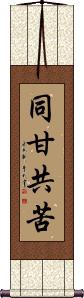
同甘共苦 is a Chinese proverb that talks of “shared delights and common hardships.”
This can be translated and understood in a few different ways, including...
To share life's joys and sorrows.
For better or for worse.
Through joys and sorrows of life.
Through all life's ups and downs.
To go through thick and thin.
To stick together through thick and thin.
To share the joys and sorrows of life.
To share pleasures and pains.
To partake in each other's joys and sorrows.
To take “for better or for worse.”
Rise and Fall / Ups and Downs
Eiko-Seisui
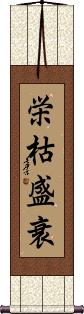
This Japanese proverb can be translated as “flourish and wither, prosper and perish,” “life is full of fortune and misfortune,” or simply “vicissitudes of life.”
栄枯盛衰 / 榮枯盛衰 is about the rise and fall of human affairs or the ups and downs of life. Prosperity comes and goes, everything is fleeting and temporary, but like waves, another swell of prosperity may come.
Here's how the Kanji break down in this proverb:
栄 = prosper; thrive; flourish; boom.
枯 = wither; die.
盛 = prosperous; flourishing; thriving; successful; energetic; vigorous; enthusiastic.
衰 = become weaker; decline; get weak; die down; subside; abate; fail.
 Notes: The original version of the first character looks like the image to the right. In modern Japan, they simplified that Kanji a bit into the version shown above. If you have a preference for which style is used for your calligraphy, please let me know when you place your order.
Apparently, with that original version of the first character, this is also used in Korean Hanja. However, I have not confirmed that
it’s
used in the same way or is widely-known in Korean.
Fatal error: Cannot redeclare foreignPrice() (previously declared in /home/gwest/web/chinesescrollpainting.com/public_html/includes/currencyconverter.php:22) in /home/gwest/web/orientaloutpost.com/public_html/includes/currencyconverter.php on line 22