Many custom options...


And formats...



Not what you want?
Try other similar-meaning words, fewer words, or just one word.
True Love in Chinese / Japanese...
Buy a True Love calligraphy wall scroll here!
Personalize your custom “True Love” project by clicking the button next to your favorite “True Love” title below...
True Love
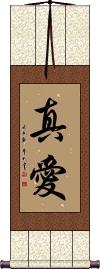
真愛 is literally “True Love” in Chinese.
The first character means “real,” “true,” and “genuine.” The second character means “love” and “affection.”
During the customization of your calligraphy wall scroll, there is a place to add an inscription. You might want that inscription to be your names in Chinese down the side of your wall scroll or perhaps just below these two main characters (just $9 extra). A nice gift to celebrate an anniversary or marriage!
True Love
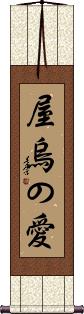
屋烏の愛 is a Japanese way to express true love or deep love.
The phrase literally suggests that this is a love for someone so strong that it can reach a crow perched on that person's roof.
My True Love
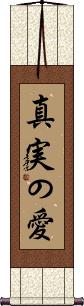
真実の愛 means “true love” or “genuine affection” in Japanese.
The first two Kanji mean true, real, genuine, or authentic.
The third Kanji is a connecting possessive article.
The last character is love or affection.
My True Love
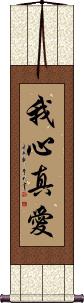
我心真愛 is a slightly poetic way to express this sentiment to someone.
The meaning is “My True Love,” but the characters directly translate as “I/Me/My Heart/Mind True/Real Love.”
Note that Chinese grammar and construction are different, so this sounds very eloquent and artsy in Chinese.
In Korean Hanja, the third character should be written differently. Just let me know when you place your order if you want that version - it will still make sense in Chinese. This phrase makes sense in Korean but is not commonly used.
Sincere / True Sincerity
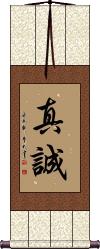
真誠 is the true essence of sincerity.
It takes strength of personality to be truly sincere without overdoing it. Speaking of strength, this is probably the strongest way to convey the idea of sincerity in the Chinese language.
The first character literally means true, real, and genuine. While the second character means sincere and honest.
True Heart
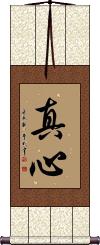
While 真心 literally reads as “true heart” or “genuine heart,” the understood meaning is sincerity, devotion, sincere, or heartfelt. Some will extend the meaning to be like “true love.” It's the idea of doing something or treating someone with genuine feelings.
真心 is valid and has the same meaning in both Chinese characters and Japanese Kanji.
Note: While not too common, this can be the female given name “Mami” in Japanese.
True / Real / Genuine
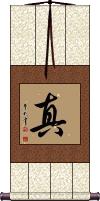
真 is a simple way to express the idea that something is real, true, truth, or genuine.
Occasionally, this character refers to a Buddhist sect that originated in the 13th century.
真 is commonly used as a compound with other characters to create ideas like “true love.” It's also used similarly to the English words “really” or “truly” to say “really good” or “He is really knowledgeable.” Those phrases start with “他真的是... (note the second character is 真).
There are two ways to write this character, shown here is the most common way in China; however, a slight stroke variation is used in Korean Hanja. If you want that version, just let us know when you place your order.
See Also: Honesty
Home is where the heart is
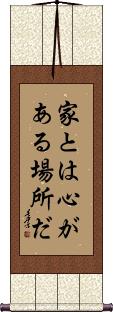
家とは心がある場所だ is, “Home is where the heart is,” in Japanese.
Most Japanese will take this to mean:
If you are with the person or at the place you love most, it becomes your true home.
Note: Because this selection contains some special Japanese Hiragana characters, it should be written by a Japanese calligrapher.
Fatal error: Cannot redeclare foreignPrice() (previously declared in /home/gwest/web/chinesescrollpainting.com/public_html/includes/currencyconverter.php:22) in /home/gwest/web/orientaloutpost.com/public_html/includes/currencyconverter.php on line 22