Many custom options...


And formats...



Unbroken in Chinese / Japanese...
Buy an Unbroken calligraphy wall scroll here!
Personalize your custom “Unbroken” project by clicking the button next to your favorite “Unbroken” title below...
Unbroken
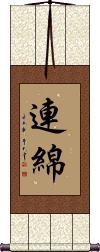
連綿 is a Chinese and Japanese Kanji word meaning: continuous; unbroken; uninterrupted; extending forever into the distance (of a mountain range, river, etc.).
Death Before Dishonor
Better to be broken jade than unbroken pottery
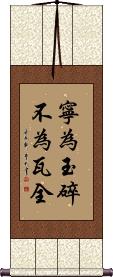
寧為玉碎不為瓦全 is the long version of a Chinese proverb that means “rather be shattered piece of jade than an unbroken piece of pottery.”
A little more explanation:
Death is implied with the “broken” meaning. Jade is one of the most precious materials in Chinese history, and in this case, is compared with one's honor and self-worth. Pottery is just something you eat off of, it has no deep value, just as a person who has lost their honor, or had none to begin with.
Thus, this means “better to die with honor than to live in shame” or words to that effect.
寧為玉碎不為瓦全 is often translated in English as “Death Before Dishonor,” the famous military slogan.
I would also compare this to the English proverb, “Better to die on your feet than to live on your knees.”
This is an idiom. It therefore doesn’t directly say exactly what it means. If you think about the English idiom, "The grass is always greener," it does not directly say "jealousy" or "envy" but everyone knows that it is implied.
Death Before Dishonor
Better to be broken jade than unbroken pottery
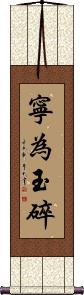
寧為玉碎 is the short version of a longer Chinese proverb which means “rather be shattered piece of jade than an unbroken piece of pottery.”
寧為玉碎 says the “rather be a broken piece of jade” part (the second half is implied - everyone in China knows this idiom).
A little more explanation:
Death is implied with the “broken” meaning. Jade is one of the most precious materials in Chinese history, and in this case, is compared with one's honor and self-worth. Pottery is just something you eat off of; it has no deep value, just as a person who has lost their honor or had none to begin with.
Thus, this means “better to die with honor than to live in shame” or words to that effect.
This is often translated in English as “Death Before Dishonor,” the famous military slogan.
I would also compare this to the English proverb, “Better to die on your feet than to live on your knees.”
Fatal error: Cannot redeclare function foreignPrice() (previously declared in /home/gwest/web/chinesescrollpainting.com/public_html/includes/currencyconverter.php:22) in /home/gwest/web/orientaloutpost.com/public_html/includes/currencyconverter.php on line 22