Many custom options...


And formats...



Universal Love in Chinese / Japanese...
Buy an Universal Love calligraphy wall scroll here!
Personalize your custom “Universal Love” project by clicking the button next to your favorite “Universal Love” title below...
Universal Love
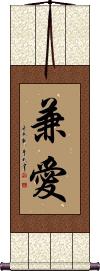
兼愛 is a Chinese word that means “universal love,” a principle advocated by philosopher Mozi (墨子), stressing that people should care for everyone equally.
Love Forever / Love Eternal
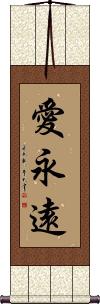
The first character here means “love.”
The last two mean forever, eternity, eternal, perpetuity, immortality, and/or permanence.
愛永遠 is the shortest and most universal way to express this idea in Chinese and Japanese.
Japanese note: This sound more like a title than a phrase in Japanese (if that makes any sense). 愛永遠 is a great title for a romantic book, the title of a movie, the name of a perfume, or even a name for a store.
See Also: Eternal Love | Forever Love
Peace and Love
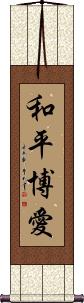
和平博愛 is the Chinese and Japanese way to express “Peace and Love.”
These are two separate words, so the calligrapher will put a slight space between the first two characters, which mean peace, and the last two, which represent universal love. This space is not shown on the sample character images for this phrase.
A special note: Word lists may seem okay in English but feel strange in Chinese and Japanese. We don't offer too many of them but this one is often-requested and feels okay in Chinese and Japanese, though a bit uncommon in Korean.
Love and Affection
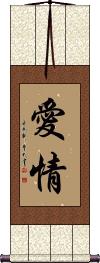
愛情 is a universal word in Japanese, Korean, and Chinese which means love and affection.
Some may translate this as “love between a man and a woman.”
Depending on the context, it can mean utter devotion or favorite.
Love for Humanity / Brotherly Love
benevolence, love
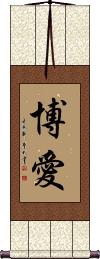
In Chinese and Korean, 博愛 means a universal fraternity, brotherhood, or universal love.
In Japanese, this means charity, benevolence, philanthropy, or love for humanity.
Please note these subtle differences and take that into account depending on your intended audience (Chinese, Korean or Japanese).
See Also: Benevolence | Altruism
Mercy / Compassion / Love
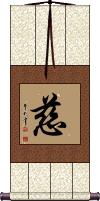
慈 is the simplest way to express the idea of compassion.
This can also mean love for your fellow humans, humanity, or living creatures. Sometimes this is extended to mean charity.
This term is often used in a Buddhist or Christian context. The concept was also spoken of by Laozi (Lao Tzu) in the Dao De Jing (Tao Te Ching).
慈 is considered the direct translation of the Sanskrit word मैत्री (maitrī) Pali word मेत्ता (mettā). In this context, it means benevolence, loving kindness, and goodwill.
This Chinese character is understood in Japanese but is usually used in compound words (not seen alone). Also used in old Korean Hanja, so it's very universal.
See Also: Mercy | Benevolence | Forgiveness | Kindness
Soul Mates
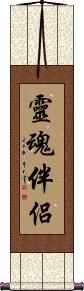
靈魂伴侶 is the literal translation of “Soul Mates.”
This is kind of the western way to express “soul mates” but translated into Chinese, Japanese Kanji, and old Korean Hanja.
The first two characters mean “soul” or “spirit.”
The second two characters mean “mate,” “companion” or “partner.”
Although not the most common title, these characters have good meaning and will be received well in Chinese, Japanese, and Korean. It's a universal title!
Lust / Desire / Passion
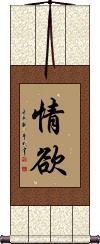
情欲 can be defined as lust, sexual desire, sensual desire, carnal desire, carnal passions, sexual desire, and passion.
The first character means feeling, emotions, passionate, sympathy, affection, love, compassion, tender feelings, and sometimes circumstances or facts.
The second character means desire, longing, appetite, wish, covetousness, greed, passion, desire, and craving.
This word is universal in Chinese, Japanese Kanji, and Korean Hanja.
Rose Flower
(The flower of love)
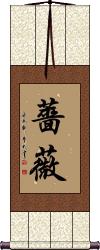
薔薇 is the universal way to write rose (as in the flower) because it is understood in both Chinese and Japanese (same characters in either language). 薔薇 is also a common way to write about roses in Asian poetry. This can be translated as “wild rose” if you are looking for that title.
薔薇 is also how to write “rose” in old Korean Hanja (though they now use Hangul, and most Koreans of this generation will not be able to read this without a dictionary).
Fatal error: Cannot redeclare foreignPrice() (previously declared in /home/gwest/web/chinesescrollpainting.com/public_html/includes/currencyconverter.php:22) in /home/gwest/web/orientaloutpost.com/public_html/includes/currencyconverter.php on line 22