Many custom options...


And formats...



Walk in the Way in Chinese / Japanese...
Buy a Walk in the Way calligraphy wall scroll here!
Personalize your custom “Walk in the Way” project by clicking the button next to your favorite “Walk in the Way” title below...
Walk in the Way
The Way of Buddha Truth
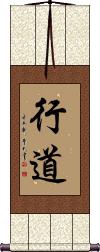
In Taoist and Buddhist contexts, 行道 means to “Walk in the Way.” In Buddhism, that further means to follow the Buddha truth. In some Buddhist sects, this can mean making a procession around a statue of the Buddha (always with the right shoulder towards the Buddha).
Outside of that context, this can mean route (when going somewhere), the way to get somewhere, etc.
In Japanese, this can be the surname or given name Yukimichi.
I walk my own path
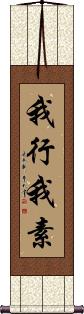
我行我素 is a way to say, “I walk my own path,” or “to continue in one's own way,” in Chinese.
This does not always have a completely positive connotation. It can mean ignoring advice or to persist in your path, no matter what others say or think.
The Tao or Dao of Being Human / Humanity
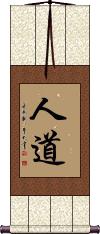
人道 is literally the “The Way of Being Human,” or “The Human Way.” It can also be translated as “humanity.”
人道 has a secondary meaning of “sidewalk” as in “the way for people to walk” (in Japanese and Korean only). But as calligraphy artwork, nobody will read it with that translation.
Please note that there are two ways to Romanize Dao or Tao (Daoism = Taoism). It's the same word in Chinese.
Galatians 5:25
If we live in the Spirit, let us also walk in the Spirit
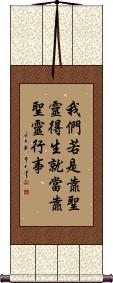
我們若是靠聖靈得生就當靠聖靈行事 is the translation of Galatians 5:25 into Mandarin Chinese via the Chinese Union Bible.
KJV: If we live in the Spirit, let us also walk in the Spirit.
NIV: Since we live by the Spirit, let us keep in step with the Spirit.
The annotation of this Chinese translation:
1.我们 wǒ men - we / us / ourselves
2.若是 ruò shì - if
3.靠 kào - depend upon / lean on / near / by / against / to support
4.圣灵 shèng líng - Holy Ghost
5.得 děi - to have to / must / ought to / degree or possibility
6.生就 shēng jiù - born one way or another (nervous, suspicious, etc.)
7.当 dàng - suitable / adequate / fitting / proper
8.靠 kào - depend upon / lean on / near / by / against / to support
9.圣灵 shèng líng - Holy Ghost
10.行事 xíng shì - how one does things / how one runs things (in this case, it suggests, “to walk in step with”)
No man knows what he owes to his parents until he comes to have children of his own
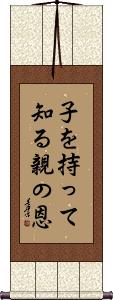
子を持って知る親の恩 literally translates as: Only after you have a baby, you would appreciate your parents (feel the way they do, etc).
This is a bit like the “walk a mile in another man's shoes” saying. Basically, it's about you cannot fully understand the plight of others until you experience it yourself. It also shows appreciation for the plight of parents.
This Japanese proverb can also be translated a few more ways:
No man knows what he owes to his parents till he comes to have children of his own.
One knows not what one owes to one's parents till one comes to have children of one's own.
Only after you have a baby, you will appreciate your parents or feel the way they do.
Only after becoming a parent yourself do you realize how much you owe [how indebted you are] to your own parents.
Note: Because this selection contains some special Japanese Hiragana characters, it should be written by a Japanese calligrapher.
Fatal error: Cannot redeclare function foreignPrice() (previously declared in /home/gwest/web/chinesescrollpainting.com/public_html/includes/currencyconverter.php:22) in /home/gwest/web/orientaloutpost.com/public_html/includes/currencyconverter.php on line 22