Many custom options...


And formats...



Wave in Chinese / Japanese...
Buy a Wave calligraphy wall scroll here!
Personalize your custom “Wave” project by clicking the button next to your favorite “Wave” title below...
Wave
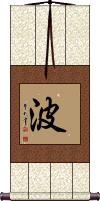
波 is the most simple way to express wave in Chinese, Japanese Kanji, and Korean Hanja.
This single character means wave. In Japanese, this is pronounced “nami” which is the same “nami” as used in the word “tsunami” (harbor wave).
Wave
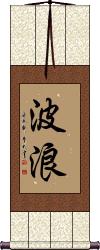
If you like to ride a surfboard, and/or “The Way of the Wave” is your life, 波浪 could be the scroll for you.
The additional meanings contained in these characters include ripple, storm, surge, breaker, wandering, and unrestrained.
Big Wave
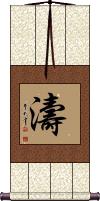
濤 is the Chinese character for “Big Wave.”
It suggests a wave unlike most, strong and powerful.
濤 is technically also a Japanese Kanji, and Korean Hanja but it's not commonly used in those Asian languages. Pronunciation in Japanese and Korean is provided above for reference only. Just order this if your audience is Chinese.
The Way of the Wave
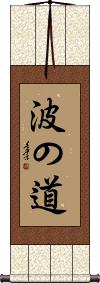
波の道 is the simple way to write “The Way of the Wave” in Japanese.
I added this at the request of several customers. 波の道 is not a very common Japanese phrase.
波 = Wave
の = Of
道 = Way
The word order is the opposite of English. Most Japanese phrases that end in “の道” are translated to English as “The Way of...”
Technically, you could write “波道” as a shorter version of “The Way of the Wave.” However, without context, 波道 can mean channel or suggest a path to redirect ocean flow.
The Way of the Wave
The Tao of the Waves
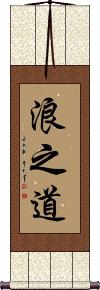
浪之道 is a great title for a surfer whose lifestyle is entwined with the surf and waves.
This can be translated a few different ways:
The Way of the Wave
The Dao of the Wave
The Tao of the Waves
Note: Dao and Tao are the same character (道), just sometimes romanized differently.
Tsunami / Tidal Wave
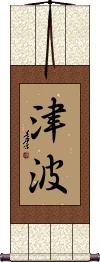
津波 is the most common way to write tsunami in Japanese.
This version should be considered “Japanese only,” as it's very uncommon to see this version used in Chinese.
Note: Can also be the surname Tsuwa in Japanese.
Tsunami / Tidal Wave
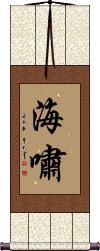
海嘯 is a common way to write tsunami in Japanese and Chinese (there's more than one way to write the same word).
Note: Can also be written as 津波, 海嘯 or 海啸.
Tsunami / Tidal Wave
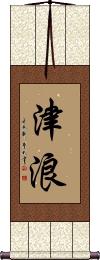
津浪 is another way to write tsunami in Japanese and Chinese (there's more than one way to write the same word).
Note: Can also be the surname Tsuha in Japanese.
Storm
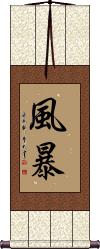
風暴 is the Chinese word for storm.
If the meaning of storm is somehow important or significant to you, these are the characters you want.
The first character means wind, and the second means violent or sudden.
Note: This would be understood in Korean Hanja, however, Koreans would generally use these characters in reverse order.
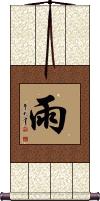
Rain
Storm / Windstorm
Best for Japanese audience
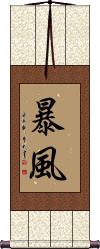
暴風 is the Japanese Kanji and old Korean Hanja word for storm (can also mean gale, tempest, typhoon, hurricane, gale, violent wind, or windstorm - especially in Korean and Chinese).
If the meaning of storm is somehow significant to you, these are the Kanji you want.
The first Kanji means violent or sudden. The second Kanji means wind.
This also means storm in Chinese but more in regards to a wind storm than a general storm. It's about the same for this word in Korean.
Carry On, Undaunted
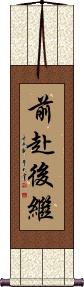
前赴後繼 is a Chinese proverb that figuratively means “to advance dauntlessly in wave upon wave.”
It suggests that you should or can carry on and have the strength to keep going.
While this proverb is a little bit militaristic, it suggests that despite a fallen comrade (or perhaps a loved one), you should keep going and work towards the goal they intended.
Beau
This is a common transliteration to Mandarin Chinese for the name Beau.
This Chinese character means “wave.”
No Limitations
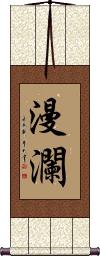
漫瀾 is the Chinese, Japanese Kanji, and old Korean Hanja for “Having no boundaries or limitations.”
This literally talks of the vastness of an ocean or river.
Character breakdown:
漫 = free; unrestrained; to inundate; overflowing; boundless.
澜 = swelling water; large wave.
Chung Do Kwan
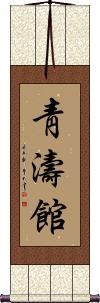
靑濤館 is the Korean martial arts style, Chung Do Kwan, meaning “Blue Wave School.”
If you want this in modern Korean Hangul characters, click on the Hangul next to the Korean flag above instead of the button above.
Also Romanized as “Cheong Do Gwan” or “Ch'ŏng Do Kwan.”
Inspiration
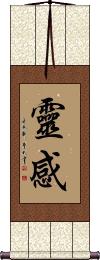
靈感 is the Chinese word closest to hitting the mark for the English word inspiration.
In a more extended context, I have even seen this translated as “brain wave.”
The first character means alert, departed soul, efficacious, quick, effective, or intelligent.
The second character means to feel, to move, to touch, or to affect.
The combined meaning of these two characters changes a bit, but I think it's nice to know the individual meanings to give you a better understanding of where a word comes from.
You could describe this word as “the thought that pops into your head just before you patent the greatest widget ever invented that everyone in the world will want.”
At least, that's the idea.
This term can also mean “intelligent thought” if you translate it directly from each character. If you are looking for inspiration or need to be inspired, this is the word for you.
 When the first character was absorbed into Japanese from Chinese, an alternate form became the standard in Japan. The Kanji shown to the right is the form currently used in Japan. This is still considered an alternate form in China to this day.
it’s
readable by both Chinese and Japanese people but if your audience is Japanese, I recommend the Kanji shown to the right - just click on that Kanji to order that version.
When the first character was absorbed into Japanese from Chinese, an alternate form became the standard in Japan. The Kanji shown to the right is the form currently used in Japan. This is still considered an alternate form in China to this day.
it’s
readable by both Chinese and Japanese people but if your audience is Japanese, I recommend the Kanji shown to the right - just click on that Kanji to order that version.
Fatal error: Cannot redeclare function foreignPrice() (previously declared in /home/gwest/web/chinesescrollpainting.com/public_html/includes/currencyconverter.php:22) in /home/gwest/web/orientaloutpost.com/public_html/includes/currencyconverter.php on line 22