Many custom options...


And formats...



White in Chinese / Japanese...
Buy a White calligraphy wall scroll here!
Personalize your custom “White” project by clicking the button next to your favorite “White” title below...
1. White
2. White Lotus
3. White Tiger
4. White Crane
5. White Dragon
9. White Swan
10. White Stork
12. White Stork
15. The White Hairs of Old Age
16. Black or white cat matters not as long as it can catch mice
18. Freedom from Anger and Worry Yields Longevity
19. Arctic Fox
21. Black Belt
22. Belarus
23. Gray Color
24. Birch
25. Lion Dance
26. Equality
27. Goldfish
28. Giant Panda
29. Jade
30. Panda Bear
31. Just as Liquor Turns a Face Red, Gold Turns a Heart Black
32. Sanchin
34. Rank Holder
36. Tai Chi Chuan / Tai Ji Quan
White
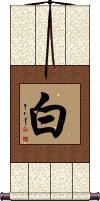
A lot of people search our website for “white.” I am not sure of the purpose unless your family name is white.
白 is the universal character for white in Chinese, Japanese Kanji, and old Korean Hanja.
In a certain context, outside of the white definition, it can mean snowy, empty, blank, bright, clear, plain, pure, or innocent. In Korean, this can be a family name romanized as Paek or Baeg.
White Lotus
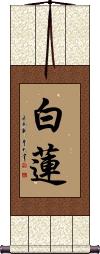
白蓮 is the title for the white lotus (flower) or a short name for the White Lotus society.
The white lotus represents purity or a pure heart and is often associated with Buddhism.
Notes: This can be the Japanese given name Byakuren. In the Buddhist context, the white lotus represented by these characters is originally puṇḍarīka in Sanskrit.
White Tiger
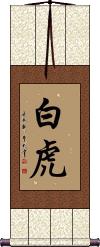
白虎 is the title “White Tiger” in Chinese, Japanese, and old Korean Hanja.
In Chinese folklore, the White Tiger rules or represents the seven mansions (constellations) of the western sky. However, in modern Chinese, a “white tiger” is also slang for hairless female genitalia (be careful about this, as Chinese men might secretly laugh or snicker when they see your white tiger wall scroll).
In Japanese folklore, the White Tiger is a god said to rule over the western heavens. They also know of the Chinese seven mansions of the western heavens. In Japanese, this can also be the given name Byakko.
White Crane
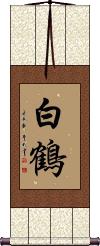
白鶴 means White Crane.
This title directly means “White Crane” in Chinese, but in English, this particular crane is referred to as the “red-crowned crane” or “Grus Japonensis.” This crane is mostly white with a red bill (crown).
White Dragon
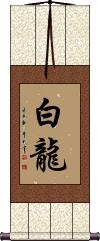
白龍 is a sophisticated or scholarly way to say “White Dragon.” 白龍 is the title you'd expect in ancient Chinese literature.
The first character means white, pure, or bright.
The second character means dragon.
The White Dragon represents a king who is virtuous and pure.
Swan / White Crane
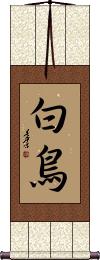
白鳥 is the Japanese Kanji and old Korean Hanja title for white swan (Cygnus Bechstein).
The title literally means white-feathered bird. This title can also be used to refer to a white crane.
This can also be the Japanese surname, Hakuchou.
White Crane Fist
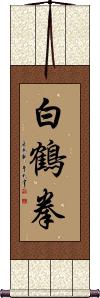
白鶴拳 is the title for the White Crane Fist style of martial arts.
白鶴拳 is also known as “Baihequan” or “Fujian White Crane.”
White Eagle Style
Bai Ying Pai
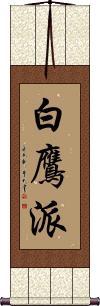
白鷹派 is the title “Bai Ying Pai” or “White Eagle School.”
The first character means white.
The second means eagle, falcon, and/or hawk.
The third means school (as in the school or style of martial arts).
White Swan
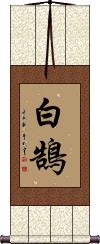
白鵠 is the Chinese title for the white swan.
It has the same meaning in Japanese but is used more often as the female given name, Akiko in Japan.
White Stork
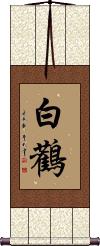
白鸛 means “white stork.”
The scientific name of this Chinese bird species is Ciconia ciconia from the stork family Ciconiidae.
White Crane Karate
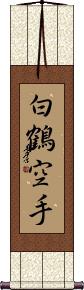
This is the title for White Crane Karate in Japanese Kanji.
White Stork
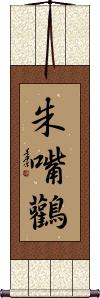
朱嘴鸛 means white stork in Japanese.
The scientific name is Ciconia ciconia.
White Crane Temple
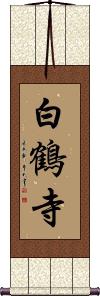
白鶴寺 is the title for White Crane Temple.
You might be looking for 白鹤萻 which is noted as the place where Mrs. Fang Qiniang (founder of the Fujian White Crane style) retired to. But this is really "White Crane Nunnery" rather than temple.
White Crane Kempo
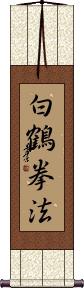
白鶴拳法 means White Crane Kenpo.
This can be romanized as Hakutsuru Kempo or Hakkaku Kenpō in Japanese.
The White Hairs of Old Age
Until death do us part
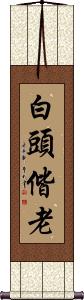
白頭偕老 is a Chinese proverb that means (to live together until the) white hairs of old age.
This is the Chinese way of saying “to live to a ripe old age in conjugal bliss” or “until death do us part.”
Black or white cat matters not as long as it can catch mice
Ability is more important than looks
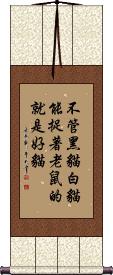
不管黑猫白猫能捉着老鼠的就是好猫 literally translates as: It doesn't matter [if a] cat [is] black [or] white, [as long as it] can catch mice, it's a good cat.
This proverb was either composed or made famous by Deng XiaoPing in 1961 when he exclaimed, “I don't care if it's a white cat or a black cat. It's a good cat so long as it catches mice” when his critics pointed out that his ideas were Capitalistic (free market). The response was meant to say, “It does not matter if it's Communist or Capitalist, as long as it works.”
This is a Chinese proverb that can be used to suggest one should disregard looks or a person's race, as long as they can do the job. It can also be used as a metaphor for many other situations.
Deng XiaoPing probably saved China from collapse (as the Soviet Union experienced). He changed China’s economy from pure Communism to a hybrid where the free market (Capitalism) is encouraged. More about Deng XiaoPing
White Bear / Polar Bear
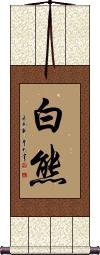
白熊 literally means “white bear.”
白熊 is a way to say “polar bear” (Ursus maritimus) in Chinese and Japanese.
This can also be the Japanese surname Shirokuma.
Freedom from Anger and Worry Yields Longevity
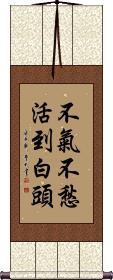
不气不愁活到白头 is a Chinese proverb that means “Without anger or worry, you will have a long life, until after all your hair is white.”
It more literally reads, “Don't get angry or worried [and you will] live [long] till [all your] hair [becomes] white.”
Arctic Fox
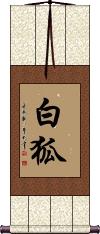
白狐 is the most common title for Arctic Fox.
白狐 is more literally “white fox.” Traditionally, the white fox or arctic fox is said to have supernatural powers.
This title can refer scientifically to the species Vulpes Lagopus.
Wisteria / Wistaria
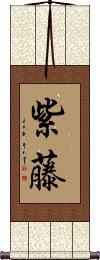
紫藤 is the Chinese name for the climbing woody vines of the genus Wisteria in the pea family featuring purplish or white flowers.
Black Belt
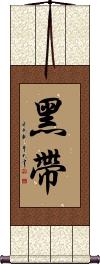
黑帶 is “black belt” in Chinese.
Many will argue whether rank systems that include a “black belt” are used in pure Chinese martial arts systems. The argument goes that it's more a Japanese idea merged into the western versions of Chinese martial arts. However, in Wushu (often referred to as Kung Fu), it's said that all students started with white belts. Over the years of training, the white belt would get dirty until finally appearing black with filth. Thus, more advanced students had darker belts.
If you want this title in Chinese, this would be the form.
 Often, the second character is written like the image to the right. If you like this version, click on this character instead of the button above.
Belarus
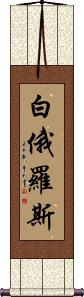
白俄羅斯 is the Chinese name for the country of Belarus or Byelorussia.
The meaning is roughly “White Russia.”
Gray Color
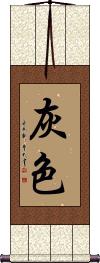
灰色 is the Chinese, Japanese Kanji, and old Korean Hanja for the color gray.
This can also mean ash gray, grizzly, pessimistic, gloomy, dispirited, ambiguous (not black and white), and the alternate spelling grey.
Birch
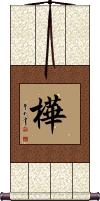
樺 is a Chinese, old Japanese Kanji, and old Korean Hanja word that means birch [tree].
If you are a botanist, this can refer to “betula japonica” or “Japanese white birch.”
Note: In Japanese, as a single Kanji, this is a little antiquated. There are several more common multi-character words that include this Kanji that specify different species of birch trees.
Lion Dance
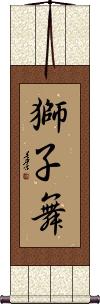
獅子舞 is the Japanese title for lion dancing.
This refers to the Japanese version borrowed from traditional Chinese culture. The Japanese version almost always features a red-faced lion with a green cloak with a white pattern.
Equality
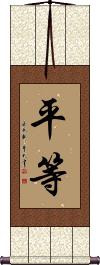
In Chinese, 平等 is the word that describes equality among all humans.
Yes, this is equality that means equality no matter of religion, whether you are rich or poor, gay or straight, black white or yellow.
In Japanese and Korean, this can be defined as equality, impartiality, and evenness (basically the same as the Chinese meaning).
Goldfish
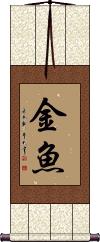
金魚 is the title for goldfish in Chinese and Japanese.
There was a time in ancient China when only the Emperor could possess the actual yellow-gold colored fish. This is why alternate coloration such as orange, black, red, and white was bred. Many believe this is why colors other than yellow-gold are more common for “goldfish” in pet shops today.
Giant Panda
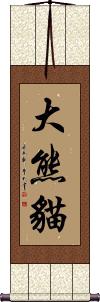
大熊貓 is how to write “giant panda” in Chinese.
大熊貓 is specific to the “giant panda,” which has black and white fur. Not to be confused with other types of smaller pandas in China.
The literal meaning of these characters is “great/big bear cat.” Chinese do think of pandas as “cat-like bears.”
Note: In Japanese, they only express Giant Panda in Katakana, which is ジャイアント パンダ” (Jaianto Panda). So we have not included that for wall scroll orders.
Jade
(precious stone)
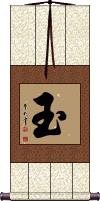
玉 is how to write jade in Chinese, Korean Hanja, and Japanese Kanji. This refers to the semi-precious stone that can be almost white or a vivid green.
Note: In Japanese, this character can mean jewel, ball, sphere or coin depending on context.
If your name is Jade, you may want to choose this to represent your name by meaning rather than pronunciation.
Panda Bear
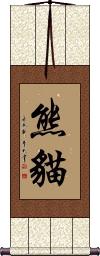
熊貓 is how to write “panda” in Chinese.
熊貓 is kind of a generic term that is applied to all pandas. When most people think of panda bears, they are really thinking of the “giant panda,” which has black and white fur.
The literal meaning of these characters is “bear cat.” Chinese do think of pandas as “cat-like bears.”
Just as Liquor Turns a Face Red, Gold Turns a Heart Black
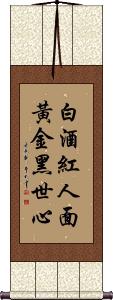
白酒紅人面黃金黑世心 literally says: [Just as] white liquor makes people's faces turn red, [So] yellow gold makes people's hearts turn black.
This is a warning about the nature of greed. The suggestion is that one who lusts for gold and riches will eventually have a black heart (or become a heartless greedy bastard). As a wall scroll, this is a reminder and warning to keep yourself from following the greedy path.
Sanchin
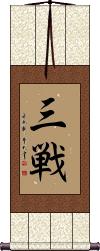
三戦 is a title that literally means “three battles/conflicts/wars.”
三戦 is often figuratively used to relay the idea of a battle to unify the mind, body, and spirit.
Original usage likely comes from Fujian province in Southern China (just across from Taiwan).
This title is used in various schools such as Okinawan Karate, Uechi-Ryū, Gōjū-Ryū, Fujian White Crane, and Five Ancestors among others.
Five Ancestors Fist
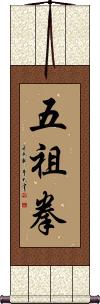
五祖拳 is a martial arts concept (or school) known as Five Ancestors' Fist.
The first character means five.
The second means ancestor, forefather, or grandparents.
The third means fist.
The ancestors referred to by this title and whose attributes contribute to this style are as follows:
1. Grace of the White Crane.
2. Agility of the Monkey.
3. Precision and skill of Emperor Taizu (great mythical ancestor).
4. Power of Luohan (Buddhist arhat).
5. Breath of Damo (founder of Buddhism, or the first Buddha).
Rank Holder
The one who has achieved rank in martial arts
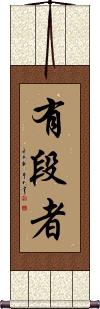
有段者 is a Japanese term for someone who holds rank in karate, judo, etc.
This term theoretically applies to anyone with rank (above a white belt). However, some schools or dojos may reserve this title for a holder of a black belt.
I'd suggest that you only order this phrase if you have honestly reached this level.
This title does kind of make sense in Chinese but only to those Chinese who practice “kong shou dao” (karate) or when used in the context of martial arts.
Southern Praying Mantis
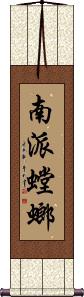
南派螳螂 can be translated literally as “Southern School Praying Mantis” or “Southern Style Praying Mantis.”
Despite its name, the Southern Praying Mantis style of Chinese martial arts is unrelated to the Northern Praying Mantis style. Southern Praying Mantis is instead related most closely to fellow Hakka styles such as Dragon and more distantly to the Fujian family of styles that includes Fujian White Crane, Five Ancestors, and Wing Chun.
This style of martial arts focuses more on fighting skills rather than aesthetics.
Of course, you already knew that if you were looking for this term.
Note: This title can be pronounced and does have meaning in Korean but only to Koreans familiar with Chinese martial arts.
Tai Chi Chuan / Tai Ji Quan
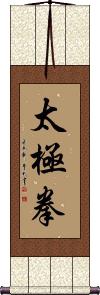
太極拳 is the famous Taoist meditation and martial art exercise. The direct translation of these characters would be something like “grand ultimate fist,” but that does not quite hit the mark for what this title really means.
An early-morning walk through any city in China near a park or an open area will yield a view of Chinese people practicing this ancient technique.
A typical scene is an old man of no less than 80 years on this earth, with a wispy white beard and perhaps a sword in one hand. He makes slow moves that are impossibly smooth. He is steady-footed and always in balance. For him, time is meaningless and proper form, and technique is far more important than speed.
For the younger generation, faster moves may look impressive and seem smooth to the casual observer. But more discipline and mental strength are needed to create perfectly smooth moves in virtual slow motion.
Note: There are two ways to Romanize these Chinese characters, as seen in the title above. The pronunciation and actual characters are the same in Chinese. If you really used English sounds/words to pronounce this, it would be something like “tie jee chew-on” (make the “chew-on” one flowing syllable).
Double Happiness Guest Book
Customize a special Asian guest book for your wedding
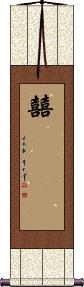
Start customizing a “Double Happiness Guest Book Wall Scroll” Here!
The paper panel length can be whatever you choose from 68cm to 135cm (27” to 53”).
If you don't mention what paper length you want in the special instructions tab (on the next page), we'll make it about 100cm (40”).
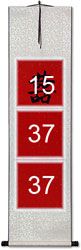
The medium-size scroll with a 33cm x 100cm (13” x 40”) paper panel can usually handle up to 89 signatures. That breaks down to 37 signatures per empty square and 15 signatures around the 囍 character. If you switch to a 135cm paper panel, add another 37 potential signatures.
We can splice two 135cm papers together, but that would be a crazy-long scroll. These are only estimates, your mileage may vary.
With silk panels, this will yield a wall scroll about 155cm (61”) long. That's enough for up to 89 signatures. Of course, that depends on if your guests just sign a brief salutation and name, or more verbose good wishes. Customer feedback is that 126 people can sign the 135cm long paper on a medium-sized scroll. If we go bigger than that, there will be a minor paper seam and an extra charge. Email me with your specifications if you need something special.
Most customers pick the festive red paper with gold flecks and white or ivory silk. Red is a good luck color in Chinese culture, thus the most popular choice. But, you can do any color combination that you want.
There is a long history of Chinese-character-use outside of mainland China. This Double Happiness character is also seen at weddings in Korea, Vietnam, Hong Kong, and Taiwan, as well as in Chinese communities in Thailand, Indonesia, and elsewhere. While Japan borrowed Chinese characters into their language, you won't see 囍 as often at Japanese weddings.
Mountain Travels Poem by Dumu

This poem was written almost 1200 years ago during the Tang dynasty.
It depicts traveling up a place known as Cold Mountain, where some hearty people have built their homes. The traveler is overwhelmed by the beauty of the turning leaves of the maple forest that surrounds him just as night overtakes the day, and darkness prevails. His heart implores him to stop, and take in all of the beauty around him.
First, before you get to the full translation, I must tell you that Chinese poetry is a lot different than what we have in the west. Chinese words simply don't rhyme in the same way that English or other western languages do. Chinese poetry depends on rhythm and a certain beat of repeated numbers of characters.
I have done my best to translate this poem keeping a certain feel of the original poet. But some of the original beauty of the poem in its original Chinese will be lost in translation.
Far away on Cold Mountain, a stone path leads upwards.
Among white clouds, people's homes reside.
Stopping my carriage I must, as to admire the maple forest at nights fall.
In awe of autumn leaves showing more red than even flowers of early spring.
Hopefully, this poem will remind you to stop, and “take it all in” as you travel through life.
The poet's name is “Du Mu” in Chinese that is: 
 .
.
The title of the poem, “Mountain Travels” is: 

You can have the title, poet's name, and even “Tang Dynasty” written as an inscription on your custom wall scroll if you like.
More about the poet:
Dumu lived from 803-852 AD and was a leading Chinese poet during the later part of the Tang dynasty.
He was born in Chang'an, a city in central China and the former capital of the ancient Chinese empire in 221-206 BC. In present-day China, his birthplace is currently known as Xi'an, the home of the Terracotta Soldiers.
He was awarded his Jinshi degree (an exam administered by the emperor's court which leads to becoming an official of the court) at the age of 25 and went on to hold many official positions over the years. However, he never achieved a high rank, apparently because of some disputes between various factions, and his family's criticism of the government. His last post in the court was his appointment to the office of Secretariat Drafter.
During his life, he wrote scores of narrative poems, as well as a commentary on the Art of War and many letters of advice to high officials.
His poems were often very realistic and often depicted everyday life. He wrote poems about everything, from drinking beer in a tavern to weepy poems about lost love.
The thing that strikes you most is the fact even after 1200 years, not much has changed about the beauty of nature, toils, and troubles of love and beer drinking.
Fatal error: Cannot redeclare foreignPrice() (previously declared in /home/gwest/web/chinesescrollpainting.com/public_html/includes/currencyconverter.php:22) in /home/gwest/web/orientaloutpost.com/public_html/includes/currencyconverter.php on line 22