Many custom options...


And formats...



Win Victory in Chinese / Japanese...
Buy a Win Victory calligraphy wall scroll here!
Personalize your custom “Win Victory” project by clicking the button next to your favorite “Win Victory” title below...
3. Know Your Enemy, Know Yourself, and You Cannot Lose
Win / Victory
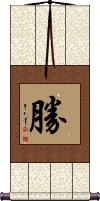
勝 is a single character that means to win or be victorious.
This can also be translated: To overcome; success; to beat; to defeat; to surpass; superior to; to get the better of; better than; surpassing; superb.
In another context, this can mean beautiful (scenery); scenic spot; or scenic beauty.
In Taiwanese Mandarin, this can be pronounced with the first tone (sheng1) and mean: Able to bear; equal to (a task).
In Japan, this can also be the name Masaru.
In Korea, this has the same meaning but can also be the surname Sŭng.
Bloodless Victory
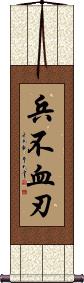
Perhaps a pacifist view or perhaps the best kind of victory; 兵不血刃 reflect this idea:
The edges of the swords not being stained with blood.
You could also translate it as: Win victory without firing a shot.
The first character means army or force. The second character means without or none. The last two characters mean bloodstained knives. So it represents a returning victorious army without bloodstained knives. 兵不血刃 is the very literal sense of this Chinese proverb. The title definition is more accurate to the way this proverb is understood.
Asking yourself why the direct or literal translation is different?
...Think of compound words in English such as “nevertheless” if we break it apart to “never the less,” we will have trouble getting the real definition of “in spite of that.” Similar things happen when multiple characters create a compounded word in Chinese.
Know Your Enemy, Know Yourself, and You Cannot Lose
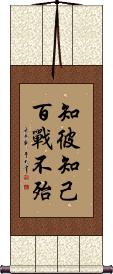
知彼知己百戰不殆 is from Sun Tzu's (Sunzi's) Art of War. It means that if you know and understand the enemy, you also know yourself, and thus with this complete understanding, you cannot lose.
This proverb is often somewhat directly translated as “Know the enemy and know yourself, and you can fight a hundred battles without defeat.”
It can also be translated as “If you know both yourself and your enemy, you can come out of hundreds of battles without danger,” or “Know your enemy, know yourself, and your victory will not be threatened.”
Know Your Enemy, Know Yourself, and Win 100 Battles
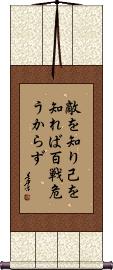
敵を知り己を知れば百戦危うからず is the longer/full Japanese version of this proverb. This means “Know your enemy, know yourself, and you will not fear a hundred battles.”
Others will translate this as “Know thy enemy, know thyself, yields victory in one hundred battles.”
Note: Because this selection contains some special Japanese Hiragana characters, it should be written by a Japanese calligrapher.
Venus / Gold Star
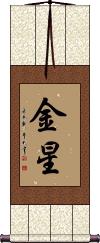
金星 literally means gold star. Most of the time, in the context of the sky, this refers to the planet Venus.
Away from the sky, this can refer to a dazzling victory (e.g. win of a rank-and-file wrestler over the grand champion) or be the Japanese surname Kinboshi.
In the Buddhist context, this is Śukra, from Sanskrit for the planet Venus.
Drain the pond to get all the fish
Kill the goose that lays the golden eggs
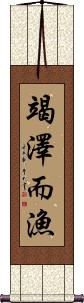
In 632 BC, Duke Wen of the Kingdom of Jin was about to lead an army against the forces of the Kingdom of Chu.
The Duke asked one of his advisers, Jiu Fan, how they could win the impending battle, as they were drastically outnumbered.
Jiu Fan said, “All is fair in war,” and suggested a plan of dishonorable tactics (cheating).
The Duke was unsure of this advice, so he asked another adviser, Yong Ji, who replied, “If you catch fish by draining the pond, you can certainly get all the fish. But there will be no fish the following year. You can cheat this one time in battle, but such tactics can only be used once, as the enemy will be wise in future encounters.”
The Duke heard the words of his wiser adviser but cheated to gain victory in the battle. However, he rewarded Yong Ji more than Jiu Fan at the victory celebration, stating that while Jiu Fan's advice gained one victory, the wise words of Yong Ji would last forever.
This Chinese idiom/proverb is still used, over 2600 years later to remind people not to burn bridges, cheat, or dishonor themselves in exchange for a short-term gain while sacrificing the future.
竭澤而漁 is very similar to the meaning of the English phrase, “Kill the goose that lays the golden eggs.”
Fatal error: Cannot redeclare function foreignPrice() (previously declared in /home/gwest/web/chinesescrollpainting.com/public_html/includes/currencyconverter.php:22) in /home/gwest/web/orientaloutpost.com/public_html/includes/currencyconverter.php on line 22