Many custom options...


And formats...



Wind and Rain in Chinese / Japanese...
Buy a Wind and Rain calligraphy wall scroll here!
Personalize your custom “Wind and Rain” project by clicking the button next to your favorite “Wind and Rain” title below...
Wind and Rain
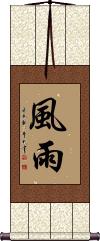
風雨 is wind and rain in Chinese, Japanese Kanji, and old Korean Hanja.
This can also refer to the elements of trials and hardships (in life).
Overcome: Regardless of the Rain and Wind
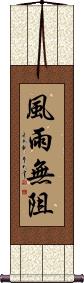
風雨無阻 is a proverb that is often translated as “Go ahead as planned regardless of the weather” or, “[Overcome] despite the rain and wind.”
This is a Chinese proverb that suggests that you are willing (or should be willing) to overcome any adversity, and accomplish your task at hand.
There is a second/optional part to this phrase that suggests that you should do this together with someone (see our other 8-character version if you want the full phrase).
Storm
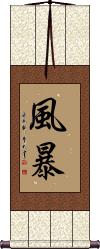
風暴 is the Chinese word for storm.
If the meaning of storm is somehow important or significant to you, these are the characters you want.
The first character means wind, and the second means violent or sudden.
Note: This would be understood in Korean Hanja, however, Koreans would generally use these characters in reverse order.
Storm / Windstorm
Best for Japanese audience
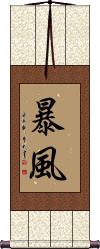
暴風 is the Japanese Kanji and old Korean Hanja word for storm (can also mean gale, tempest, typhoon, hurricane, gale, violent wind, or windstorm - especially in Korean and Chinese).
If the meaning of storm is somehow significant to you, these are the Kanji you want.
The first Kanji means violent or sudden. The second Kanji means wind.
This also means storm in Chinese but more in regards to a wind storm than a general storm. It's about the same for this word in Korean.
Shen Long
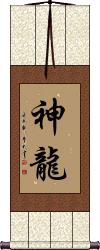
神龍 or Shen Long literally means “god dragon” or “divine dragon.”
神龍 is a spiritual dragon from Chinese mythology that controls wind, storms, clouds, and rain. Historically, farmers in China avoid offending this dragon, as it could result in a drought or flooding of their fields.
Shen Long has blue/azure scales and appears on the beautiful robes of some Chinese emperors.
Sometimes romanized as Shen Lung and sometimes written as 神竜 in Japan with the pronunciation of Shinryū or Shenron. It can also be a given name in Japan.
Regardless of the Weather, We Overcome Troubles Together
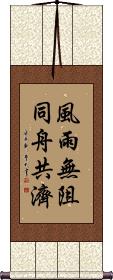
The first four characters are often translated as “Go ahead as planned regardless of the weather” or, “[Overcome] despite the rain and wind.” The last four characters can mean “Stick together” but literally means “Take the same boat [together].”
風雨無阻同舟共濟 is a Chinese proverb that suggests that you are willing (or should be willing) to overcome any adversity, and accomplish your task at hand. The second part (last four characters) is sometimes left off but this second part strongly suggests that you should overcome that adversity together.
Fatal error: Cannot redeclare function foreignPrice() (previously declared in /home/gwest/web/chinesescrollpainting.com/public_html/includes/currencyconverter.php:22) in /home/gwest/web/orientaloutpost.com/public_html/includes/currencyconverter.php on line 22