Many custom options...


And formats...



Zen Chan Meditation in Chinese / Japanese...
Buy a Zen Chan Meditation calligraphy wall scroll here!
Personalize your custom “Zen Chan Meditation” project by clicking the button next to your favorite “Zen Chan Meditation” title below...
Zen / Chan / Meditation
...as in Zen Buddhism
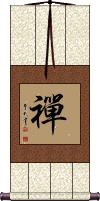
First, let's correct something: The Japanese romanization for this character, “Zen” has penetrated the English language. In English, it's almost always incorrectly used for phrases like “That's so zen.” Nobody says, “That's so meditation” - right? As the title of a sect, this would be like saying, “That's so Baptist!"
禪 by itself just means “meditation.” In that context, it should not be confined to use by any one religion or sect.
Regardless of the dictionary definition, more often than not, this character is associated with Buddhism. And here is one of the main reasons:
Zen is used as the title of a branch of Mahayana Buddhism, which strongly emphasizes meditation practice.
However, it should be noted that Buddhism came from India, and “Chan Buddhism” evolved and developed in medieval China. The Chinese character “Chan” was eventually pronounced as “Zen” in Japanese. Chan Buddhists in China have much in common with Zen Buddhists in Japan.
More about the history of Zen Buddhism here.
Please also note that the Japanese Kanji character for Zen has evolved a little in Japan, and the two boxes (kou) that you see at the top of the right side of the character have been replaced by three dots with tails.
 The original character would still be generally understood and recognized in Japanese (it's considered an ancient version in Japan) but if you want the specifically modern Japanese version, please click on the zen Kanji to the right. Technically, there is no difference between the Tensho and Reisho versions of Zen since they are ancient character styles that existed long before Japan had a written language.
 There is also an alternate/shorthand/simplified Chinese version, which has two dots or tails above the right-side radical. This version is also popular for calligraphy in China. If you want this version, just click the character to the right.
Further notes: Zen is just one of seven sects of Buddhism practiced in Japan. The others are 律 Ritsu (or Risshū), 法相 Hossō, 論 Sanron 華嚴 Kegon, 天台 Tendai, and 眞言 Shingon.
Appreciation of Truth by Meditation
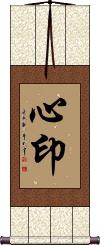
心印 is a Buddhist concept that simply stated is “appreciation of truth by meditation.”
It's a deep subject, but my understanding is that you can find truth through meditation, and once you've found the truth, you can learn to appreciate it more through further meditation. This title is not commonly used outside of the Buddhist community (your Asian friends may or may not understand it). The literal translation would be something like “the mind seal,” I've seen this term translated this way from Japanese Buddhist poetry. But apparently, the seal that is stamped deep in your mind is the truth. You just have to meditate to find it.
Soothill defines it this way: Mental impression, intuitive certainty; the mind is the Buddha-mind in all, which can seal or assure the truth; the term indicates the intuitive method of the Chan (Zen) school, which was independent of the spoken or written word.
Reference: Soothill-Hodous Dictionary of Chinese Buddhism
See Also: Zen
Sit in Meditation
Zazen
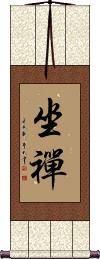
坐禪 describes the act of sitting in a state of deep meditation.
You'll notice that the second character is Chan/Zen (often used to title the meditative form of Buddhism).
In Korean Hanja, this means “religious meditation” (roughly the same as the Chinese definition).
Buddhists may define this as sitting in dhyāna, abstract meditation, fixed abstraction, or contemplation.
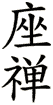 Japanese note: This will make sense in Japanese but the Kanji shown to the left are partially in ancient/traditional Japanese form. Japanese Buddhists may use 坐禪, 坐禅, 座禪, or 座禅. The most standard/modern Japanese form of this word is shown to the right. Click on the Kanji to the right (instead of the button above) if you want this specifically Japanese version.
Meditation
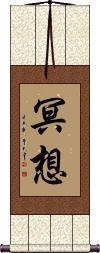
This encompasses the idea of meditation.
It's also a term used to describe a deep form of daydreaming, exploring one's imagination, the act of contemplating, or the idea of contemplation. 冥想 is often associated with Buddhism; however, the word “Zen” in Japanese (or “Chan” in Chinese) is probably more commonly used (or better known in the west).
See Also: Zen
Inner Bliss and Peace from Meditation
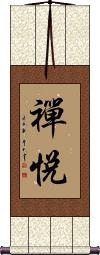
禪悅 is a title that refers to the inner bliss and peace you can achieve from meditation.
This term transcends a few religions, including Taoism and Buddhism. It can also be translated as “joy of the mystic trance” or simply “meditative bliss.”
Amazing that such a complex idea can be expressed in just two Chinese characters. Note that the first character is Chan/Zen (Chinese/Japanese), which means “meditation” in both languages.
Zendo / The Zen Way
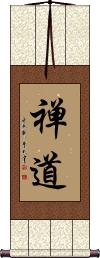
禪道 is a title used in certain contexts but is not widely known by the general population of China or Japan.
In Japanese, you will see this title romanized as “zendo,” which is the brand name of a board game, and also a title used by some martial arts studios and karate dojos. Oddly, many translate this as “zen fist,” although there is no “fist” in the title. If you literally translated this title, it would be “meditation way” or “meditation method.”
In Chinese, this would be “chan dao” with the same literal meaning as the Japanese title. It's used in China by just a handful of martial arts styles/studios.
You should only order this title if you really understand the meaning, and it has some personal connection to you (such as practicing a martial art style that uses this title, or if you love the board game Zendo). Many who see your wall scroll will not be familiar with this title, and you'll have some explaining to do.
 The first character can also be written in a more complex traditional way as shown to the right. Let us know in the special instructions for your calligraphy project if you want this style.
If you order this from the Japanese master calligrapher, the first character will automatically be written with an extra dot on top. This is the variant form of the original Chinese character which is commonly used in modern Japan Kanji. See sample to the right.
Truth Flashed Through The Mind
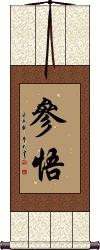
參悟 is a Chan / Zen Buddhism concept that means “to understand (mystery) from meditation” or “to see truth flash through the mind.”
參悟 is a pretty deep idea; therefore, your study and contemplation may be required before fully appreciating it.
Fatal error: Cannot redeclare function foreignPrice() (previously declared in /home/gwest/web/chinesescrollpainting.com/public_html/includes/currencyconverter.php:22) in /home/gwest/web/orientaloutpost.com/public_html/includes/currencyconverter.php on line 22