Many custom options...


And formats...



Zen Understanding in Chinese / Japanese...
Buy a Zen Understanding calligraphy wall scroll here!
Personalize your custom “Zen Understanding” project by clicking the button next to your favorite “Zen Understanding” title below...
2. Power of Understanding and Wisdom
3. A Life of Serenity Yields Understanding
4. Achieve Inner Peace; Find Deep Understanding
5. 1. Right Understanding / Right Perspective / Right View / Perfect View
7. Four Noble Truths: Suffering
10. Awareness
11. Compassion
13. Desire
15. Reality
16. Know Your Enemy, Know Yourself, and You Cannot Lose
17. All Tenets of the Noble Eightfold Path
18. Inspiration
19. Good Good Study, Day Day Up
Zen Understanding
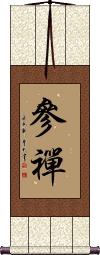
參禪 is a title that speaks of reaching an understanding (of Zen or the world). It also means “to practice meditation.” The two concepts lead you to the idea that meditation leads to understanding. 參禪 is pretty deep, so you can do your research or decide what this means for you.
This can also be defined in a more complex way as “thoroughly penetrating with meditative insight.”
Power of Understanding and Wisdom
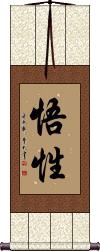
悟性 means the power of understanding and insight in Chinese.
It is often associated with Neo-Confucianism. In that regard, it means to realize, perceive, or have the perception of man's true nature. It can also mean finding your soul, the soul of others, or the soul of the world. Some will translate this simply as the state of being “savvy.”
In Japanese, this is often translated as wisdom and understanding.
A Life of Serenity Yields Understanding
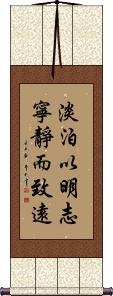
淡泊以明志寧靜而致遠 is a kind of complex ten-character proverb composed by Zhuge Liang about 1800 years ago.
This is a Chinese proverb that means “Leading a simple life will yield a clear mind, and having inner peace will help you see far (into the world).”
What I have translated as “simple life” means NOT being materialistic and NOT competing in the rat race.
The last word means “far” but the deeper meaning is that you will surpass what you can currently see or understand. Perhaps even the idea of opening up vast knowledge and understanding of complex ideas.
The whole phrase has a theme that suggests if you are NOT an aggressive cut-throat person who fights his way to the top no matter how many people he crushes on the way, and instead seek inner peace, you will have a happier existence and be more likely to understand the meaning of life.
See Also: Serenity
Achieve Inner Peace; Find Deep Understanding
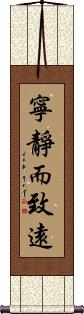
寧靜而致遠 is five characters from a longer ten-character proverb composed by Zhuge Liang about 1800 years ago.
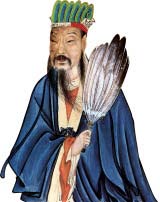
诸葛亮 Zhuge Liang
The proverb means “Your inner peace/tranquility/serenity will help you see or reach far (into the world).”
The last word means “far” but the deeper meaning is that you will surpass what you can currently see or understand. Perhaps even opening up vast knowledge and understanding of complex ideas.
1. Right Understanding / Right Perspective / Right View / Perfect View
Samyag Dristhi / Samyag Drsti / Samma Ditthi
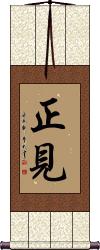
正見 is one of the Noble Eightfold Paths of Buddhism. Right View, along with the Right Thought, constitutes the path to Wisdom.
To get to the correct view of the world, you must first understand and follow Four Noble Truths.
Note: This term is exclusively used by devout Buddhists. It is not a common term, and is remains an unknown concept to most Japanese and Chinese people.
See Also: Buddhism | Enlightenment | Noble Eightfold Path
Knowledge from Experience
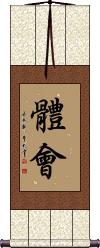
體會 is a Chinese word that basically means “knowledge [comes from] experience,” or “to learn through experience.”
This can also mean realizing or gaining understanding from your experiences.
Four Noble Truths: Suffering
Dukkha
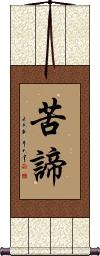
苦諦 relays that part of life in this universe is suffering.
All living things experience some form of suffering, according to Buddhist teaching.
This title is about accepting and understanding that the world is full of suffering.
This term is exclusively used by devout Buddhists. It is not a common term, and is remains an unknown concept to most Chinese, Japanese and Korean people.
See Also: Buddhism | Enlightenment
Enlightened Truth
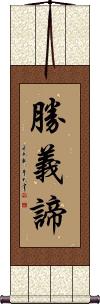
This Buddhist term means the superior truth or enlightened truth.
勝義諦 is a realm of understanding that is far beyond worldly truth.
Some will also define this as the ultimate truth.
Seeking Wisdom
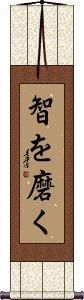
智を磨く is an old obscure Japanese phrase that means to refine, cultivate, or improve one's wisdom.
This is the mantra of one who is a seeker of wisdom. They will always want to polish, shine, refine, improve, and expand their knowledge and understanding.
Note: Because this selection contains some special Japanese Hiragana characters, it should be written by a Japanese calligrapher.
Awareness
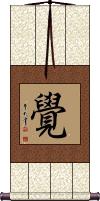
覺 can mean to feel; to figure out; thinking; awake; aware; bodhi; knowing; understanding; enlightenment; illumination; apprehend; perceive; realize.
覺 is a character that is impossible to define in a single word.
This term is often associated with Buddhism where it's understood to be: Illumination, enlightenment, or awakening in regard to the real in contrast to the seeming. However, it can also refer to enlightenment in regard to morality and evil.
Notes:
In Japanese, this can be the personal name Satoru.
In certain context, and only when pronounced as "jiao" in Chinese, it can refer to a nap, sleep or the state of sleeping. However, as a single character on a wall scroll, everyone will read this with the awareness or enlightenment context.
By no means is this the only way to write enlightenment. In fact, you should only choose this character if you are looking more for a word meaning awareness.
See Also: Enlightenment | Wisdom | Knowledge
Compassion
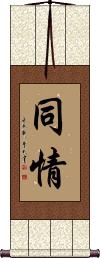
These two characters mean compassion and sympathy in Chinese, Japanese, and Korean, which makes this word universal.
Compassion is caring and understanding someone is hurt or troubled (even if you don't know them). It is wanting to help, even if all you can do is listen and say kind words. You forgive mistakes. You are a friend when someone needs a friend.
Idea / Thought / Meaning
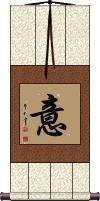
意 is the Chinese, Japanese Kanji, and old Korean Hanja for an idea, intention, meaning, thought, wish, desire, intention, feelings, and thoughts.
In Buddhism, this is the last of the six means of perception (the others are sight, hearing, smell, taste, and touch, and this one represents the mind). It does not literally mean “mind,” but rather something more like mental powers, intellect, intelligence, faculty of thought, or understanding in the Buddhist context.
Desire
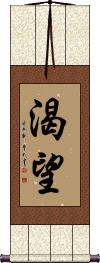
This Chinese word can mean desirous, wishful, or desire.
The first character means to thirst for [something] or to be thirsty. The second character means to hope for, to expect, to gaze (into the distance), or to look for something. The combined meaning of these two characters changes a bit, but I think it's nice to know the individual meanings to give you a better understanding of where a word comes from.
Korean definitions of this word include craving, longing, and thirst for knowledge.
Realization and Knowledge
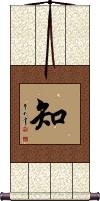
知 means realization or true knowing.
This can also translate as to know, to be aware, wisdom, or higher knowledge.
From older Buddhist ideas, this can represent विद्या (Vidyā or Vidya) or ज्ञान (Jñāna or Jnana) and even the combination Sanskrit word विज्ञान (Vijñāna or Vijnana) which can translate as wisdom arising from perception or knowing.
However, 知 should be distinguished as true knowing versus having a relative understanding or 會.
Reality
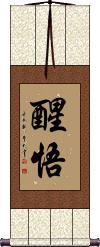
醒悟 is a Chinese word that expresses the idea of reality or coming to understand what is true and real.
The first character means to wake up, awaken, comprehend, introspect, or visit.
The second character means to comprehend or understand (be enlightened).
The meanings of Chinese words are not necessarily the sum of their parts. In this case, at best, you can derive that the characters express “understanding what is real” or “knowing what is real.” Any Chinese person will perceive this word in a similar way to how we use “reality” in English.
 Note: The first character can also be written in a different form as shown to the right. Same meaning in Chinese, either way
it’s
written.
Note: The first character can also be written in a different form as shown to the right. Same meaning in Chinese, either way
it’s
written.
Know Your Enemy, Know Yourself, and You Cannot Lose
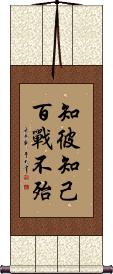
知彼知己百戰不殆 is from Sun Tzu's (Sunzi's) Art of War. It means that if you know and understand the enemy, you also know yourself, and thus with this complete understanding, you cannot lose.
This proverb is often somewhat directly translated as “Know the enemy and know yourself, and you can fight a hundred battles without defeat.”
It can also be translated as “If you know both yourself and your enemy, you can come out of hundreds of battles without danger,” or “Know your enemy, know yourself, and your victory will not be threatened.”
All Tenets of the Noble Eightfold Path
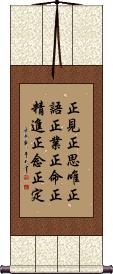
These are the eight tenets of the Buddhist Noble Eightfold Path written altogether.
Here's this list of tenets in English:
1. Right View / Right Understanding / Right Perspective / Perfect View
2. Right Resolve / Right Thought / Right Intention / Perfect Resolve
3. Right Speech / Right Talk / Perfect Speech
4. Right Action / Perfect Conduct
5. Right Living / Right Livelihood / Perfect Livelihood
6. Right Effort / Right Endeavor / Perfect Effort
7. Right Mindfulness / Right Memory / Perfect Mindfulness
8. Right Concentration / Perfect Concentration
Inspiration
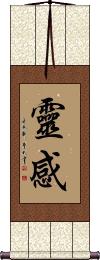
靈感 is the Chinese word closest to hitting the mark for the English word inspiration.
In a more extended context, I have even seen this translated as “brain wave.”
The first character means alert, departed soul, efficacious, quick, effective, or intelligent.
The second character means to feel, to move, to touch, or to affect.
The combined meaning of these two characters changes a bit, but I think it's nice to know the individual meanings to give you a better understanding of where a word comes from.
You could describe this word as “the thought that pops into your head just before you patent the greatest widget ever invented that everyone in the world will want.”
At least, that's the idea.
This term can also mean “intelligent thought” if you translate it directly from each character. If you are looking for inspiration or need to be inspired, this is the word for you.
 When the first character was absorbed into Japanese from Chinese, an alternate form became the standard in Japan. The Kanji shown to the right is the form currently used in Japan. This is still considered an alternate form in China to this day.
it’s
readable by both Chinese and Japanese people but if your audience is Japanese, I recommend the Kanji shown to the right - just click on that Kanji to order that version.
When the first character was absorbed into Japanese from Chinese, an alternate form became the standard in Japan. The Kanji shown to the right is the form currently used in Japan. This is still considered an alternate form in China to this day.
it’s
readable by both Chinese and Japanese people but if your audience is Japanese, I recommend the Kanji shown to the right - just click on that Kanji to order that version.
Good Good Study, Day Day Up
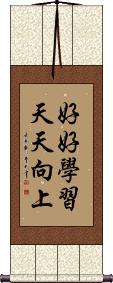
好好學習天天向上 is a famous proverb by Chairman Mao Zedong that sounds really strange when directly translated into English.
I include it in our database of phrases to illustrate how different the construction and grammar can be between Chinese and English. The direct translation is “Good Good Study, Day Day Up.” In Chinese, a repeated character/word can often serve to reinforce the idea (like saying “very” or suggesting “a lot of”). So “good good” really means “a lot of good.” While “day day” can be better translated as “day in day out.” The idea of “up” has a meaning in China of “rising above” or “improving.”
After understanding all of this, we come up with a slightly better translation of “With a lot of good study, day in and day out, we raise above.”
The more natural translation of this proverb would be something like, “study hard, and keep improving.”
Appreciation of Truth by Meditation
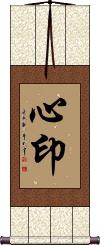
心印 is a Buddhist concept that simply stated is “appreciation of truth by meditation.”
It's a deep subject, but my understanding is that you can find truth through meditation, and once you've found the truth, you can learn to appreciate it more through further meditation. This title is not commonly used outside of the Buddhist community (your Asian friends may or may not understand it). The literal translation would be something like “the mind seal,” I've seen this term translated this way from Japanese Buddhist poetry. But apparently, the seal that is stamped deep in your mind is the truth. You just have to meditate to find it.
Soothill defines it this way: Mental impression, intuitive certainty; the mind is the Buddha-mind in all, which can seal or assure the truth; the term indicates the intuitive method of the Chan (Zen) school, which was independent of the spoken or written word.
Reference: Soothill-Hodous Dictionary of Chinese Buddhism
See Also: Zen
Crisis equals Danger plus Opportunity?
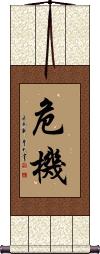
危機 means crisis in Chinese and Japanese.
Separately, the first character here does mean “danger” or “to endanger,” and the second character can mean “opportunity.”
However, I want to debunk a myth that was propagated by some westerners who did not have a clear understanding of Asian languages...
While often, Chinese/Japanese/Korean compound words (words of two or more characters) are the sum of their parts, this is not always the case. The compound is often understood with a completely different meaning than the two characters individually.
Many have said that the Chinese/Japanese/Korean word for Crisis is made up of the characters for “danger” and “opportunity.” 危機 is true when phrased this way.
However, it's not absolutely correct to say that “danger + opportunity = crisis” in Asian cultures.
English example:
If I tell you that...
Bovine creature + Guy behind the plate in baseball = Locomotive train protection

...you would think I was mad. But consider that “cow + catcher = cowcatcher,” which is the device that used to be found on steam engines to protect them if they hit an animal on the tracks. When we hear the word “cowcatcher,” we don't separate the words into their individual meanings (necessarily).
The same is true with the word for crisis in Chinese/Japanese/Korean. While you can separate the characters, few Asian people would automatically do so in their minds.
The final answer:
It is a half-truth to say, “danger plus opportunity equals crisis” in Chinese/Japanese/Korean. Use this statement and concept with caution.
Also, the second character can mean “secret” or “machine,” depending on context so I guess you have to say “a dangerous machine = crisis” or “danger + a secret = crisis.” Both of these are only slightly more ridiculous than the first premise.
PS: 危機 is probably not a great word for a scroll unless you have a special use for it.
Fatal error: Cannot redeclare foreignPrice() (previously declared in /home/gwest/web/chinesescrollpainting.com/public_html/includes/currencyconverter.php:22) in /home/gwest/web/orientaloutpost.com/public_html/includes/currencyconverter.php on line 22