Many custom options...


And formats...



Bodhisattva in Chinese / Japanese...
Buy a Bodhisattva calligraphy wall scroll here!
Personalize your custom “Bodhisattva” project by clicking the button next to your favorite “Bodhisattva” title below...
1. Bodhisattva
2. Goddess of Mercy and Compassion
7. Goddess of Mercy and Compassion
9. Guan Shi Yin: Protector Of Life
10. The Supreme Mahayana Truth
12. Grand Master / Great Teacher
13. Kind Words
Bodhisattva
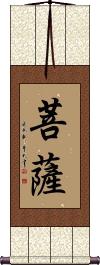
菩薩 is the title of a Buddhist deity that exists to help you reach enlightenment.
In Buddhist beliefs, a bodhisattva (bodhisatta) is dedicated to helping us achieve enlightenment. Bodhisattva means enlightenment truth which is bodhi sattva in Sanskrit.
This term is sometimes used to refer to a kindhearted person, one who will sacrifice himself/herself for others and lacks ego or desire but is instead devoted to the good and well-being of others.
See Also: Buddha | Namo Amitabha
Goddess of Mercy and Compassion
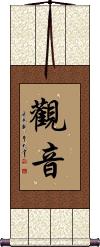
觀音/観音 is the Buddhist deity known as the Goddess of Mercy or Bodhisattva of Compassion.
In Chinese, the proper name of this being is Guan Yin. There is some debate as to whether Guan Yin is female. The argument comes from some scripture that suggests Buddhist deities take on the male form. Others say that Guan Yin has no sex. And still, others are okay with the female representation of Guan Yin.
This bodhisattva is also known or Romanized in the following ways:
Mandarin Chinese: Guan Yin, Kuan Yin, Kwan Yin.
Japanese: Kannon, Kwannon.
Sanskrit: Bodhisattva Avalokitesvara.
Korean: Gwan-eum.
Vietnamese: Quan Âm.
Thai: Kuan Eim.
English: Bodhisattva of Mercy and Salvation, Goddess of Compassion, Buddha of Mercy, et al.
Note: The first character has a slight variation in Japanese. If your audience is specifically Japanese, you may want to select that version.
See Also: Buddhism | Goddess | Namo Amitabha
Buddhism / Buddha

佛 is the essence of the Buddha or Buddhism.
Depending on the context, this word and character can be used to refer to the religion and lifestyle of Buddhism, or in some cases, the Buddha himself.
It is interesting to note that this word is separate from all others in the Chinese language. The sound of “fo” has only this meaning. 佛 is in contrast to many sounds in the Chinese language, which can have one of four tones, and more than 20 possible characters and meanings. This language anomaly shows how significantly Buddhism has affected China since ancient times.
More about Buddhism
佛 is also used with the same meaning in Korean Hanja.
It's used in the very religious context of Buddhism in Japan. It should be noted that there are two forms of this Kanji in use in Japan - this is the more formal/ancient version, but it's rarely seen outside of religious artwork and may not be recognized by all Japanese people.
It also acts as a suffix or first syllable for many Buddhist-related words in Chinese, Japanese, and Korean.
See our Buddhism & Zen page
See Also: Enlightenment
Namu Amida Butsu
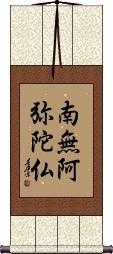
南無阿弥陀仏 is the modern Japanese version of “Namu Amida Butsu” or “The Compassionate Amitabha Buddha.”
Some will translate this as “I sincerely believe in Amitabha; Lord have mercy on me.”
This phrase especially applies to Japanese Pure Land Buddhists.
There is a universal version using ancient characters (with more strokes) for the 4th and last characters. That version is also used in Chinese, Korean, and occasionally Vietnamese.
This is used to pay homage to Amitabha Buddha.
Namo Amitabha Buddha
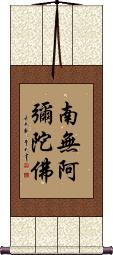
南無阿彌陀佛 is how to express “The Compassionate Amitabha Buddha” (especially for the Pure Land Buddhist Sect).
Some will translate as “Homage to Amitâbha Buddha” or “I seek refuge in the Amitâbha Buddha.”
This is valid in Chinese characters, Japanese Kanji, and old Korean Hanja.
Sometimes modern Japanese use a different version of the 4th and last Kanji, but the version shown here is the most universal.
This is used to pay homage to Amitabha Buddha.
Namu Dai Bosa
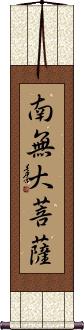
南無大菩薩 means to submit to or pay homage to the great Bodhisattva.
The last three characters, 大菩薩, can mean bodhisattva-mahāsattva, refer to one who has reached enlightenment but vows to save all beings before becoming a buddha or a high and noble monk.
Goddess of Mercy and Compassion
This is the long or more formal version of this title
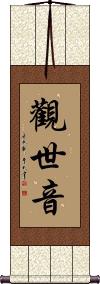
觀世音 is the longer and perhaps more formal title for the Buddhist deity known as the Goddess of Mercy or Bodhisattva of Compassion.
The longer title of this bodhisattva is Romanized in the following ways:
Mandarin Chinese: Guanshi Yin, Kuan-shih Yin.
Japanese: Kanzeon.
Sanskrit: Bodhisattva Avalokitesvara.
Korean: Gwan-se-eum.
Vietnamese: Quan Thế Âm.
Thai: Prah Mae Kuan Eim.
English: Bodhisattva of Mercy and Salvation, Goddess of Compassion, Buddha of Mercy, et al.
Please view our more common and shorter version, “Guan Yin” before you make a decision. Also, note that the first character has a slight variation in Japanese. If your audience is specifically Japanese, you may want to select that version.
Namo Guanshiyin Pusa
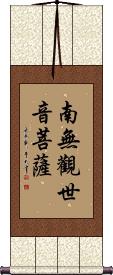
南無觀世音菩薩 means homage to the Bodhisattva Avalokitêśvara in Chinese and Japanese.
The 4th character of this homage or chant can be dropped, making it 南無觀音菩薩 or “Namo Guanyin Pusa.”
Guan Shi Yin: Protector Of Life
觀世音 is an alternate title for Guanyin, the Bodhisattva of Compassion or Goddess of Mercy.
觀世音 is the Buddhist bestower of children, the protector of life and all in distress (especially of those at sea).
The Supreme Mahayana Truth

大乘無上法 means the supreme Mahāyāna truth.
This refers to the ultimate reality in contrast with the temporary and apparent. Other translations include “the reliance on the power of the vow of the bodhisattva” or “the peerless great vehicle teaching.”
Note: This may suggest that Mahayana Buddhism, as practiced in China, Japan, Korea, Vietnam, and other regions is superior (with subtle arrogance) to the original Theravada (or old school) Buddhism. Mahayana and Theravada Buddhists generally get along better than Catholics and Protestants, but there have been schisms.
Namo Guanyin Pusa
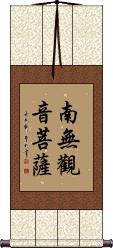
南無觀音菩薩 is the title Namo Guanyin Pusa in Chinese or Namu/Namo Kannon Bosatsu in Japanese.
This can also translate as Namo Avalokitesvara Bodhisattva.
Note: Sometimes written 南無觀世音菩薩 (just the addition of 世) making it Námó Guānshìyīn Púsà.
Grand Master / Great Teacher

大師 is a way to title a great master, grand master, or great teacher.
This can be used in the context of martial arts or a Buddhist teacher. Thus, it can be used to title a living Buddha, Bodhisattva, or high-ranking monk.
Kind Words
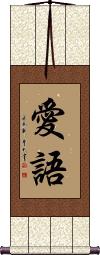
In the simplest terms, 愛語 means kind words.
In the Buddhist context, this is one of the four methods of approach to people which the bodhisattvas use to guide them to the way of the Buddha.
Other translations include loving speech or simply the words of a bodhisattva.
愛語 is also a common female name, Aigo, in Japanese.
Goddess of Compassion
Long or more formal Japanese version of this title

観世音 is the more extended and more formal Japanese version of Bodhisattva of Compassion or Guan Yin.
In Japanese, this is pronounced Kanzeon. The Chinese version is a bit more common in Asia, but in Japanese, they use a slight variation of the first character. Choose this version only if your intended audience is specifically Japanese.
Goddess of Compassion
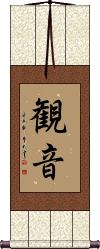
観音 is the specifically Japanese version of Bodhisattva of Compassion or Guan Yin.
In Japanese, this is pronounced Kannon and occasionally spelled Kwannon. The Chinese version is a bit more commonly seen in Asia. However, in Japanese, there is a slight variation with the first character.
Some time ago, a camera company in Japan named their company after this Buddhist deity. That camera company is still known as Canon (they chose a “C” instead of a “K” when they Romanized this name).
Light / Bright and Promising Future
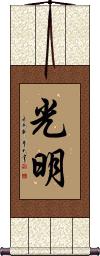
光明 is a nice way to say “light” in Chinese and old Korean Hanja.
This is because the word also suggests a bright future or refers to someone who is very promising (great future potential).
The first character means light or bright.
The second character means bright and clear (in this context).
This word appears in most Japanese dictionaries, but it is not the most common Japanese Kanji word for light (more commonly used for the name Mitsuharu).
In old Korean Hanja, this can also mean brightness or brilliance.
In the context of Buddhism, this means “Light emanating from a Buddha or Bodhisattva, symbolizing their wisdom and compassion.”
Fatal error: Cannot redeclare foreignPrice() (previously declared in /home/gwest/web/chinesescrollpainting.com/public_html/includes/currencyconverter.php:22) in /home/gwest/web/orientaloutpost.com/public_html/includes/currencyconverter.php on line 22