Many custom options...


And formats...



Darkness in Chinese / Japanese...
Buy a Darkness calligraphy wall scroll here!
Personalize your custom “Darkness” project by clicking the button next to your favorite “Darkness” title below...
Darkness
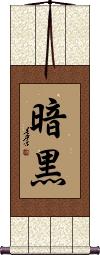
暗黒 is the two-character Japanese word for darkness.
The first Kanji can mean unilluminated, dark, gloomy, hidden, or secret.
The second character means black or dark.
Together, these two Kanji will be understood as dark or darkness.
Darkness
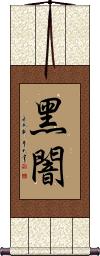
黑闇 is the two-character Chinese word for darkness.
The first character alone means black or dark.
The second character has several possible meanings, depending on context; They include: to shut the door, unilluminated, dark, gloomy, hidden, or secret.
Together, these two characters will, in most cases, be translated as dark or darkness.
Darkness
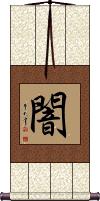
闇 is the shortest and universal way (in Chinese, Japanese Kanji, and old Korean Hanja) to write “darkness.”
In Chinese, this can mean dark, gloomy, hidden, secret, to shut the door, or unilluminated.
In Japanese, this can mean darkness, the dark, black-marketeering, dark, shady, or illegal.
In old Korean Hanja, this can mean dark, obscure, hidden, or secret.
 Note that there is an alternate form of this character. It is used as an alternate in all three languages (that rarely happens). You can see this alternate version to the right. If you want to order that version, please click on that character, instead of the button above.
The Night is Darkest Before the Dawn
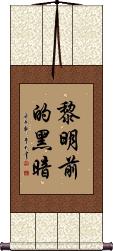
黎明前的黑暗 is the most natural way to write “The night is darkest before the dawn,” in Chinese.
The words break down this way by meaning this way:
1.黎明 dawn or daybreak
2.前 before, in front, ago, former, previous, and/or earlier
3.的 (possessive particle) of
4.黑暗 dark, darkly, or darkness
If you try to understand the Chinese word order and grammar, it's like, “Before dawn is the darkest [time].”
You must endure a harsh winter to appreciate the warmth of springtime
You must know hardship to appreciate happiness
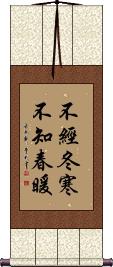
This literally translates as: Without having experienced the cold of winter, one cannot appreciate the warmth of spring.
Figuratively, this means: One cannot truly appreciate happiness without having gone through hardship.
There are many contrasts in life. One simply cannot fully know what joy is without having experienced misery, difficulty, and pain. How could you explain “light” if you did not have “darkness” to compare it to?
Embrace hardship, as it makes the good times seem even better.
Comparison Leads to Truth and Enlightenment
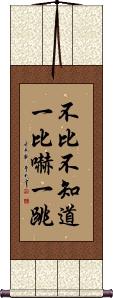
不比不知道一比吓一跳 is a Chinese proverb that literally means: [If one not does] not make comparisons, [one will] not know [the truth] when [one] compares, [one will be] greatly surprised.
This goes to the idea that if you do not know bad times, you cannot know what good times are.
...And...
You can not know light without experiencing darkness.
Another way to translate this would be: If you wish to be enlightened, you need to make comparisons and analyze every aspect (of a situation, issue, or problem).
Fatal error: Cannot redeclare foreignPrice() (previously declared in /home/gwest/web/chinesescrollpainting.com/public_html/includes/currencyconverter.php:22) in /home/gwest/web/orientaloutpost.com/public_html/includes/currencyconverter.php on line 22