Many custom options...


And formats...



Faith in God in Chinese / Japanese...
Buy a Faith in God calligraphy wall scroll here!
Personalize your custom “Faith in God” project by clicking the button next to your favorite “Faith in God” title below...
1. Religious Devotion / Faith in God / Religious Faith
2. Trust in God / Faith in God
5. Faith
10. Faith / Trusting in the Unseen
11. Faith is the bird that feels the light when the dawn is still dark
12. Believe
13. Faithful / Honorable / Trustworthy / Fidelity / Loyalty
14. Trust in God
15. Trust in God / Belief in God
16. Trust in God / In God We Trust
17. Sacrifice / Devotion / Dedication
18. Devotion / Diligence / Vigorous / Energetic
19. Good Intentions / Good Will / Good Faith
21. Hope
Religious Devotion / Faith in God / Religious Faith
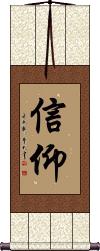
信仰 means firm belief, faith, persuasion, conviction, and sometimes religion or creed in Chinese, Japanese Kanji, and old Korean Hanja.
This clearly fits the religious connotation of the English word “devotion.”
This is often used to refer to a person of faith or a religious person.
This can be directly translated as “firm belief,” “creed,” “conviction,” or simply as “religious,” depending on context.
Some will also use this to mean “trust in God” in Japanese (though the term for God is not actually in this title).
It should be noted that this word is a little strange alone on a wall scroll.
While this can be pronounced in Japanese, it’s not a great selection for a wall scroll if your audience is Japanese.
See Also: Faith | Trust | Devotion | Trust | Trust in God
Trust in God / Faith in God
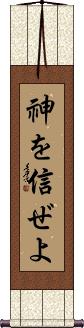
神を信ぜよ is a way to express “Trust in God” in Japanese.
The first character is “God.”
The second character is a particle that links the ideas here.
The last three characters are a word that means “to believe,” “to believe in,” “to place trust in,” “to confide in,” and “to have faith in.”
Basically, this is the Japanese phrase for “Have faith in God,” “Belief in God,” or “Trust in God.”
Note: Because this selection contains some special Japanese Hiragana characters, it should be written by a Japanese calligrapher.
Believe / Faith / Trust
śraddhā
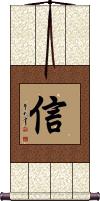
信 can mean to believe, truth, faith, fidelity, sincerity, trust, and confidence in Chinese, old Korean Hanja, and Japanese Kanji.
This single character is often part of other words with similar meanings.
It is one of the five basic tenets of Confucius.
In Chinese, it sometimes has the secondary meaning of a letter (as in the mail) depending on context but it will not be read that way when seen on a wall scroll.
In the Buddhist context, this is śraddhā (faith through hearing or being taught).
Trust / To Have Faith
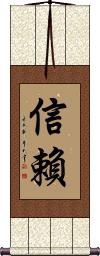
信賴 can also be translated as confidence, reliance, or dependence; thus, it can also mean “to rely on” or “to depend on.”
Trust is having faith in someone or something. It is a positive attitude about life. You are confident that the right thing will happen without trying to control or make it happen. Even when difficult things happen, trust helps us to find the gift or lesson in it.
 There is a slight deviation in the Japanese Kanji form of the second character. If you want the modern Japanese version, please click on the special Kanji shown to the right instead of the button above. Note that the traditional Chinese form is still readable and understood by Japanese people.
See Also: Confidence | Truth | Honor
Faith
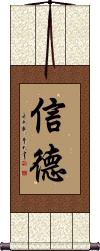
信德 is a term used often in Buddhism to express faith.
信德 is sometimes translated as the merit of the believing heart, faith of virtue, the power of faith, or virtuous faith.
In this context:
信 = Faith
德 = Virtue
Love Faith Strength
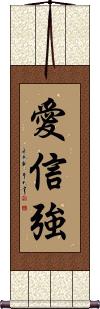
愛信強 is the shortest way to write the word list, “love faith strength.”
The first character is love, the second is faith or believe, and the third means strong or strength.
It should be noted that word lists like this are not as natural sounding in Chinese as word lists can be in English. it’s more common to have a full phrase (with subject, verb, and object) or single words on calligraphy wall scrolls in Asia.
Love Faith Strength
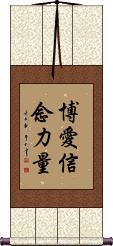
博愛信念力量 is the verbose way to write the word list, “love faith strength.”
It should be noted that word lists like this are not as natural sounding in Chinese as word lists can be in English. it’s more common to have a full phrase (with subject, verb, and object) or single words on calligraphy wall scrolls in Asia.
Faith Love Peace
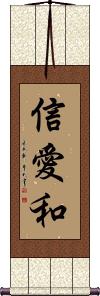
信愛和 is a word list that reads, “Faith Love Peace.”
This is not a natural phrase in Chinese or Japanese, as it lacks a subject, verb, or object. But if this is what you want, here it is.
Faith Hope Love
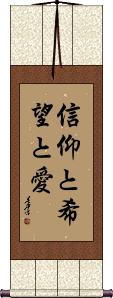
信仰と希望と愛 is a Japanese list of words (not really a phrase) meaning faith, hope, and love.
Some have associated this word list with Corinthians 13:13, though there are no specific religious connotations in this word list, and it's not directly from that Japanese Bible verse.
Note: Because this selection contains some special Japanese Hiragana characters, it should be written by a Japanese calligrapher.
Faith Hope Love
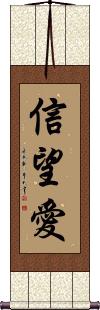
信望愛 is a Chinese list of words meaning faith, hope, and love.
This is not a typical phrase in Chinese but rather just random words strung together. There's no bad meaning, it's just not typical Chinese grammar.
Firm Belief / Strong Faith
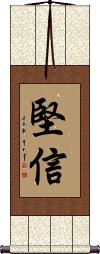
堅信 means to believe firmly, with firm faith, or without any doubt.
Japanese Christians sometimes use this term to mean the rite of confirmation.
This can also be the Japanese given name Kenshin.
Faith / Trusting in the Unseen
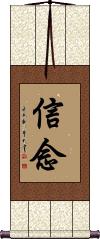
信念 expresses the idea of “having a belief” or “trusting in the unseen.”
信念 could also be translated as beliefs or convictions.
Note: Also considered to be one of the Seven Heavenly Virtues.
See Also: Devotion | Dedication | Trust
Faith is the bird that feels the light when the dawn is still dark
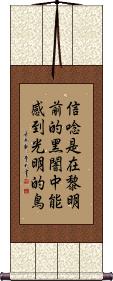
信唸是在黎明前的黑闇中能感到光明的鳥 is a philosophical poem/quote from Indian Poet and Philosopher, Rabindranath Tagore.

Rabindranath Tagore, 1915
This quote is not sourced, and therefore several variations exist in English. Some suggest the original was in the Bengali language.
This, of course, is the Chinese translation that has the meaning of, “Faith is the bird that feels the light and sings when the dawn is still dark.”
More about Rabindranath Tagore
Believe
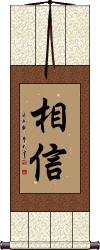
相信 is the Chinese way to say believe.
This specifically means to be convinced that something is true or to accept something as true or real.
This can also be translated as “convinced of,” “have trust in,” or “have faith in.”
Faithful / Honorable / Trustworthy / Fidelity / Loyalty
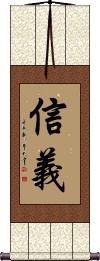
信義 is a word often used to describe a person with an honest and loyal reputation.
Simply put, this applies to somebody you can trust (with your life).
In Chinese, this is often defined as good faith, honor, trust, and justice.
In Korean, this word means fidelity, truthfulness, or faithfulness.
In Japanese: faith, fidelity, and loyalty. It's also a Japanese male given name when pronounced “Nobuyoshi.”
Trust in God
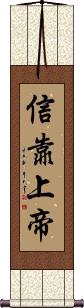
信靠上帝 means “Trust in God,” “Faith in God,” “Rely upon God” and/or “Believe in God.”
Trust in God / Belief in God
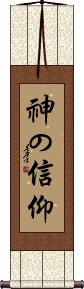
神の信仰 is the simplest way to express “Trust in God” in Japanese.
The first character means God, deity, divinity, or spirit (in this case, it will be read as God).
The second character is a particle that links the ideas.
The last two characters mean faith, belief, or creed in a religious context.
Trust in God / In God We Trust
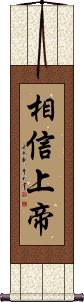
相信上帝 means exactly what the title suggests. The first two characters mean “trust” or “believe,” and the second two mean “God” (as in the God of Abraham and the God of Zion).
Thisis also how the American phrase “In God We Trust” as seen on U.S. Currency would be translated into Chinese. It would also be correct to say that this means “Believe in God,” though, in this arrangement/context, one would be more likely to interpret it as “trust.”
Sacrifice / Devotion / Dedication
(complete bodily devotion)
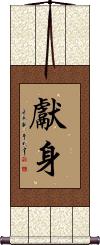
獻身 is used to describe being so devoted to something that you will make sacrifices for that goal/thing/person.
You can also translate this word as any of the following:
Sacrifice one's life for...
To dedicate oneself to...
Self-devotion
Dedication
Devote to...
Self-sacrifice
Giving your whole body to...
This can be a dedication to or for someone but is often used as a dedication or making sacrifices for your country, public service, or a cause. For instance, an Olympic athlete makes great sacrifices to train in his/her sport for their country and compatriots.

 While the form shown to the upper-left is considered an ancient Japanese version, in modern Japan, they use the simplified version of the first Kanji (shown to the right). Click on the Kanji at the right instead of the button above if you want this modern Japanese version.
If you are looking for a more religious meaning of devotion, see Faith.
See Also: Confidence | Dedication
Devotion / Diligence / Vigorous / Energetic
vīrya
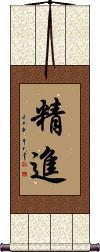
精進 is a wide-ranging word that is used in Chinese, Japanese, and Korean.
It can mean devotion, diligence, concentration, aggressive, enterprising, vigorous, energetic, purification, pushing, asceticism, assiduity, or virility. 精進 is deep, and these two characters can express ideas that take a full English phrase to describe, such as “concentration of mind,” “to forge ahead vigorously,” or “to dedicate oneself to progress.”
Used in the context of Buddhism, it means “making earnest efforts to cultivate virtue and get rid of evil” or “zeal in one's quest for enlightenment.”
Good Intentions / Good Will / Good Faith
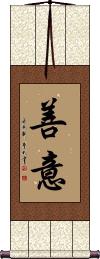
善意 is a word that means good intentions, goodwill, or to things done in good faith in Chinese, Japanese, and old Korean Hanja.
It's the reason you do good deeds or the desire you have inside yourself to do the right thing.
This can also be translated as benevolence, kindness, virtuous mind, positive mindset, or favorable sense.
善意 is also used in the legal context for things done in good faith (regardless of outcome).
In Japanese, this can be the personal name Yoshi or Yoshii.
Sincerity and Devotion
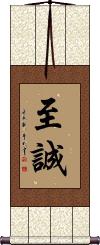
至誠 is the idea that you enter into something with the utmost sincerity and fidelity. Ideas such as devotion, honesty, and “one's true heart” are also contained in this word.
至誠 is a universal word as the Chinese, Japanese Kanji, and Korean Hanja are all identical.
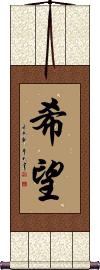
Hope
Devotion / Dedication / Attentive / Focused
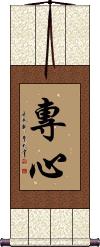
專心 makes a word that means “paying attention with your heart.”
It's often translated as “dedication,” as in “be absorbed in” or “concentrate one's efforts.” It's also used to mean “with the single mind,” “whole-heartedly,” “paying attention,” “undivided attention,” “concentration (-ed),” “engrossed,” “devotionally (listening/watching),” and/or “attentive.”
The first character means “for a particular person, occasion, or purpose,” “focused on one single thing,” “concentrated,” and sometimes, “special.”
The second character means “heart” or “mind” by itself.
My favorite translation, which comes from the Oxford Advanced Chinese/English Dictionary, is, “wholehearted devotion.”
If it seems like the meaning of this word is quite open, you are correct. The context in which the word is used matters a lot. It can mean different things depending on how you use it. This makes it kind of nice as you can decide what this means to you (within some limits). This is always positive in meaning, so even if a Chinese person reads it differently than you, it will still have a good meaning.
 In Japanese, they tend to use a variation of the second character which has one less stroke. If you want your calligraphy written this Japanese form, please click on the Kanji shown to the right instead of the button above. Note: Japanese and Chinese people will recognize either form.
Fatal error: Cannot redeclare foreignPrice() (previously declared in /home/gwest/web/chinesescrollpainting.com/public_html/includes/currencyconverter.php:22) in /home/gwest/web/orientaloutpost.com/public_html/includes/currencyconverter.php on line 22