Many custom options...


And formats...



Inner Strength in Chinese / Japanese...
Buy an Inner Strength calligraphy wall scroll here!
Personalize your custom “Inner Strength” project by clicking the button next to your favorite “Inner Strength” title below...
2. Inner Strength is Better than Outward Appearance
3. Inner Strength / Self-Improvement
4. Inner Strength is Better than Outward Appearance
5. Always Striving for Inner Strength
6. Inner Strength / Inner Well-Being and Health
7. With all the strength of your heart
8. Spiritual Strength / Strength of Spirit
10. Fortitude / Strength of Character
14. Flexibility Overcomes Strength
16. Strength and Love in Unity
29. Indomitable / Persistence / Fortitude
30. Conquering Yourself is a Sign of Strength
31. Strength: Strong and Solid
34. Strong / Healthy
35. Vitality
36. Strong Woman
37. Strong / Healthy
39. Strong / Robust
40. Mighty / Powerful / Strong
43. Perseverance / Indomitable / Invincible Fortitude
44. Tempering Makes Strong Steel
47. Determination to Achieve / Will-Power
48. Strong Hearted / Strong Willed
49. Perseverance
51. Healthy Living
52. Undaunted After Repeated Setbacks
53. Creativity
55. Imagination
56. No Pain No Gain
57. Intensity
58. Lee
61. Great Power
62. Mind Over Matter
63. Daodejing / Tao Te Ching - Chapter 33
69. Resilience / Restoration / Recovery
70. Know Thy Enemy, Know Thyself
71. Cooperation
72. Dragon
73. Hapkido
Inner Strength
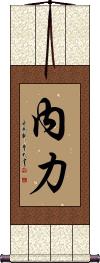
內力 is the shorter version of inner strength (can also be translated as “internal force”). The first character holds the meaning of “inner” or “internal.” The second character means “power,” “force,” or “strength.”
內力 is a Kung Fu way of talking about an inner power or strength from within. This is a way to express “inner chi.” This is something that you might hear in a real Chinese Kung Fu movie.
While understood in Chinese and Japanese, this can have a secondary meaning of “inner stress” in Japanese.
Inner Strength
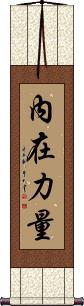
內在力量 is the slightly-verbose way to say inner strength.
The first two characters mean “intrinsic” or “inner.” The second two characters mean “power,” “force” or “strength” (especially physical strength). 內在力量 is more a short phrase rather than just a word in Chinese and Korean. This can sort of be understood in Japanese but it's not normal/proper Japanese.
Inner Strength is Better than Outward Appearance
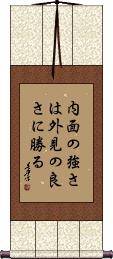
内面の強さは外見の良さに勝る is a Japanese proverb that literally translates as “inner/internal strength/power [versus] outward-appearance [the] merit/virtue/good quality [does] excel/surpass/exceed/outweigh.”
More naturally in English, this would be “Inner Strength Outweighs Outward Appearance.”
Note: Because this selection contains some special Japanese Hiragana characters, it should be written by a Japanese calligrapher.
Inner Strength / Self-Improvement
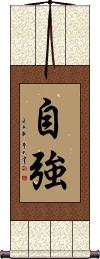
自強 is the kind of inner strength that applies to a person who has will-power and can inspire themselves to do great things.
自強 can also be the creed of a person that always pursues self-improvement.
Other translations: self-strengthening, striving for improvement, self-improvement, striving to become stronger, and self-renewal.
Inner Strength is Better than Outward Appearance
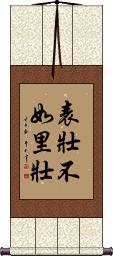
表壯不如里壯 literally translates as: [Better to be] strong inside than [to be] strong outside.
The ancient original meaning was:
[An] able [husband] outside [working to support a family is] not as good as [an] able [wife] inside [working and saving to take care of the family].
The current meaning is:
Inner strength is more important than outward appearance.
Always Striving for Inner Strength
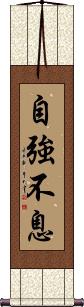
自強不息 is a proverb or idiom that suggests that the pursuit of self-improvement is eternal. It can also be a suggestion to strive unremittingly in life.
The first two characters mean inner strength with the idea of self-improvement. The last two characters mean “never rest” or “striving without giving up.”
Some will translate these four characters as “Exert and strive hard without any let-up.”
Inner Strength / Inner Well-Being and Health
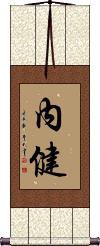
內健 is an old Chinese word meaning inner strength or inner health.
It's the idea of health and well-being starting or residing inside yourself. Also defined as fortitude within the context of good health.
With all the strength of your heart
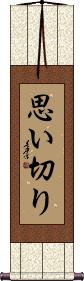
思い切り can be translated as “with all one's strength,” “with all one's heart,” “to the limits of your heart,” or “to the end of your heart/emotions.”
The character breakdown:
思い (omoi) thought; mind; heart; feelings; emotion; sentiment; love; affection; desire; wish; hope; expectation; imagination; experience
切り (kiri) bounds; limits.
Note: Because this selection contains some special Japanese Hiragana characters, it should be written by a Japanese calligrapher.
Spiritual Strength / Strength of Spirit
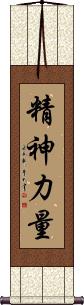
精神力量 is a title that speaks of one's soul or spirit and the capacity or strength that soul possesses.
The first two characters mean mind, heart, spirit, and/or soul.
The last two characters mean strength, capacity, or ability.
Note: Separately, these are two words in Japanese and can be pronounced, but this does not make a natural title in Japanese (best if your audience is Chinese).
Power / Strength
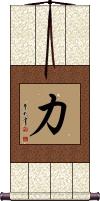
力 is the simplest form of “power” or “strength.”
In Japanese, it is pronounced “chikara” when used alone, and “ryoku” when used in a sentence (there are also a few other possible pronunciations of this Kanji in Japanese).
In some contexts, this can mean ability, force, physical strength, capability, and influence.
Fortitude / Strength of Character
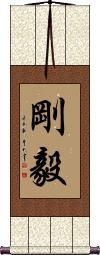
剛毅 is a Japanese and Chinese word that means resolute and firm, fortitude, firmness of character, hardihood, manliness, or macho.
See Also: Perseverance | Strength | Tenacity
Strong / Powerful
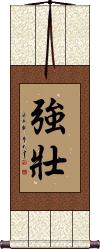
強壯 is an adjective that means powerful or strong.
It can also be translated as able-bodied, robust, or sturdy.
This version of strength also suggests muscularity.
 Note that the second character was simplified in Japan after WWII (also simplified in mainland China but not for calligraphy). If you want the modern Japanese/simplified version, please click on the Kanji shown to the right.
Strength / Ability
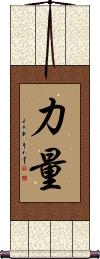
力量 is a general strength term.
It can refer to mental or physical strength (depending on context). 力量 can also be used to describe strength in terms of capability, capacity, ability, and even tact. Some may translate this as power or force.
Herculean Strength
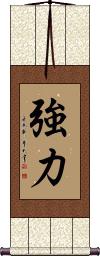
強力 means herculean strength, powerful, or strong.
I've even heard this described as “strength to carry a mountain.”
Note: This can also be the Japanese surname Gouriki (like Mr. Strong).
Flexibility Overcomes Strength
Softness Overcomes Hardness
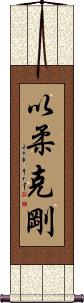
以柔克剛 can be translated as “Softness Overcomes Hardness,” “Flexibility Overcomes Power,” “Flexibility Overcomes Strength,” “Overcoming Powerful Strength with Flexibility,” or “Use Softness to Conquer Strength.”
Strength and Courage
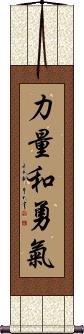
While 力量和勇氣 is not a typical Chinese phrase, this is how to write “strength and courage.”
If this is an important idea for you, we can make a great custom Chinese “strength and courage” wall scroll for you.
Strength and Love in Unity
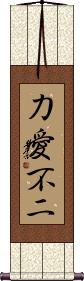
力愛不二 is a proverb that literally means:
“Strength [and] Love [are] Not Two [separate ideas/concepts/things].”
You'll find this proverb translated from Japanese to English as:
Love and strength are not separate.
Power and love are indivisible.
Strength and love in harmony.
Strength and love stand together.
Old Japanese grammar is quite different than English, and so this proverb says a lot within the brevity of just 4 characters. If you just read these characters directly as “Strength Love Not Two,” you'd probably miss the real meaning.
According to the Swedish Shorinji Kempo Federation, this is the second characteristic of Shorinji Kempo.
This post really explains the concept best in my opinion: Bushido by MS: Riki Ai Fu Ni, which states: "Riki Ai Funi" is the philosophy that power (Riki) and love (Ai) are indivisible. More concretely, a person, who is powerful but does not have love, cannot control and misuse his/her power; on the other hand, a person, who has loved ones but is not powerful enough, cannot protect himself/herself nor loved ones.
Strength and Honor
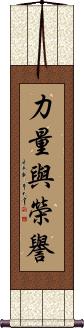
力量與榮譽 is “strength and honor” in Chinese.
The first two characters are usually understood as (physical) strength but can also mean power or force.
The middle character is a connecting particle similar to “and.”
The last two characters are a way to say honor but can also be understood as honorable reputation, honorary, or glory.
Strength and Honor
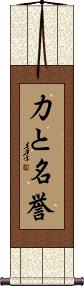
力と名譽 is “strength and honor” in Japanese Kanji (with one Hiragana).
The first Kanji is understood as strength, power, or force.
The second character is a connecting particle-like, “and” or “with.”
The last two Kanji mean honor/honour, credit, or prestige. This last word is also used in the Bushido code to mean honor.
Love Faith Strength
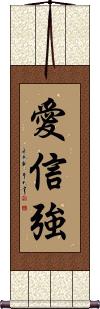
愛信強 is the shortest way to write the word list, “love faith strength.”
The first character is love, the second is faith or believe, and the third means strong or strength.
It should be noted that word lists like this are not as natural sounding in Chinese as word lists can be in English. it’s more common to have a full phrase (with subject, verb, and object) or single words on calligraphy wall scrolls in Asia.
Physical Strength
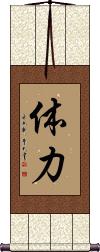
体力 means “physical strength” or “physical power.”
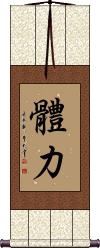
The first character was first simplified in Japan. Later, that simplified version became the standard in mainland China. Just in case you want this version, it is offered here. I suggest it if your audience is Japanese. Most Chinese know the older traditional version, which looks like 體力.
体力 can also be defined: stamina; endurance; physical strength; resilience; resistance to disease; clout; stability.
Strength and Courage
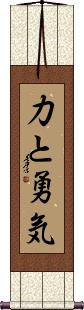
力と勇気 may not be the most common Japanese phrase, but this is how to write “strength and courage” or “power and bravery” in Japanese.
Strength and Love
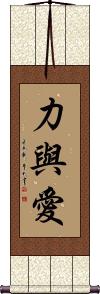
While not a common title for a wall scroll in China, 力與愛 means “strength and love” or “power and love” in Chinese characters.
Physical Strength
Courage and Strength
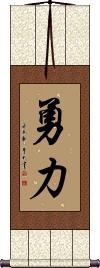
勇力 is a very short way to say “courage and strength” in Chinese and Japanese.
In Japanese, it's read more like “strong courage” or “powerful courage.” This can also be the personal name Yuri or Yuuri in Japanese.
Love Faith Strength
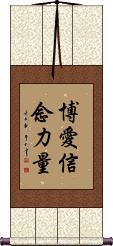
博愛信念力量 is the verbose way to write the word list, “love faith strength.”
It should be noted that word lists like this are not as natural sounding in Chinese as word lists can be in English. it’s more common to have a full phrase (with subject, verb, and object) or single words on calligraphy wall scrolls in Asia.
Strength Love Honor
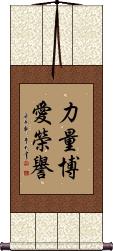
力量 博愛 榮譽 is the verbose way to write the word list, “strength love honor.”
It should be noted that word lists like this are not as natural sounding in Chinese as word lists can be in English. it’s more common to have a full phrase (with subject, verb, and object) or single words on calligraphy wall scrolls in Asia.
God Give Me Strength
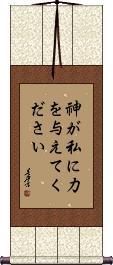
神が私に力を与えてください is “God give me strength” in Japanese.
This is the long and formal version. We also have a short version.
Note: Because this selection contains some special Japanese Hiragana characters, it should be written by a Japanese calligrapher.
Strength / Vigor / Energy
Physical Strength
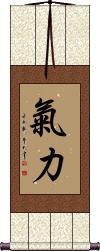
氣力 can mean any of the words in the title above, and in some contexts, can also mean effort, will-power, or talent.
This refers mostly to physical strength (as opposed to mental or spiritual).
 In modern Japan, they use a simplified first character for this word. If you want to order this title with that special Japanese version, click on the character to the right instead of the button above.
God Give Me Strength
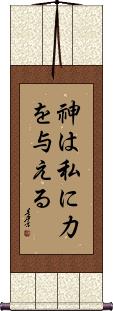
神は私に力を與える means “God give me strength,” in Japanese.
神は私に力を與える is the short version, we also have a longer more formal version.
Note: Because this selection contains some special Japanese Hiragana characters, it should be written by a Japanese calligrapher.
Indomitable / Persistence / Fortitude
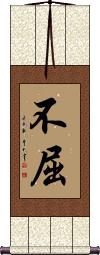
不屈 is the short form of a longer Chinese word and also a word used in Korean and Japanese to express the idea of being indomitable. It literally means “will not bend,” “will not crouch,” “will not yield,” “will not flinch,” or “will not submit.”
Note: Some will translate this as “indomitable spirit”; however, technically, there is no character to suggest the idea of “spirit” in this word.
Conquering Yourself is a Sign of Strength
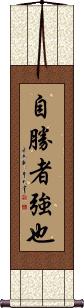
自勝者強也 means “One who conquers oneself is strong” in Chinese.
自勝 = Self-overcoming or self-conquering
者 = is
強 = Strength
也 = Also
Strength: Strong and Solid
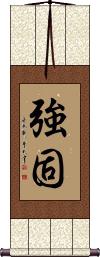
強固 means firmness, stability, security, and strength in Japanese.
It's not used commonly in China, but it means “powerful,” “firm,” “solid,” “strong,” or “better than others” in Chinese. There is a slight variation in the top of the first character between Chinese and Japanese. Because this is more of a Japanese word, we are showing the Japanese form here.
強固 is also a Korean word, but Korean Hanja uses the Chinese form of the first character (one tiny stroke is a little different), so just let me know if your audience is Korean when you place your order, and we'll have it written in the Chinese/Korean version.
Indomitable / Unyielding
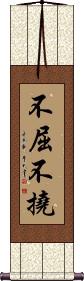
不屈不撓 means “Indomitable” or “Unyielding.”
不屈不撓 is a long word by Chinese standards. At least, it is often translated as a single word into English. It's actually a proverb in Chinese.
If you want to break it down, you can see that the first and third characters are the same. Both mean “not” (they work as a suffix to make a negative or opposite meaning to whatever character follows).
The second character means “bendable.”
The last means “scratched” or “bothered.”
So this really means “Won't be bent, can't be bothered.” I have also seen it written as “Will not crouch, will not submit.” This comes from the fact that the second character can mean “to crouch” and the last can mean “to submit” (as in “to give in” such as “submitting to the rule of someone else”). This may explain better why these four characters mean “indomitable.”
Notes:
Some will translate this as “indomitable spirit”; however, technically, there is no character to suggest the idea of “spirit” in this word.
Other translations include indefatigability, indomitableness, or unremitting tenacity.
The first two characters can be stand-alone words in Chinese.
In Japanese, this is considered two words (with very similar meanings). It's more common to see the word order flipped to 不撓不屈 in Japanese.
The same characters are used in old Korean Hanja. Just like in Japanese, the words are swapped to 不撓不屈 creating a word pronounced “불요불굴” in Korean.
See 不撓不屈
God Give Me Strength
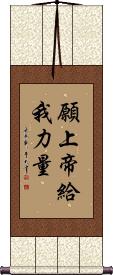
願上帝給我力量 is a wish or a prayer that you might call out at a desperate time.
Translated by us for a military serviceman in Iraq. He may need to use this phrase often, though I am not sure where he's going to find a place to hang a wall scroll.
Strong / Healthy
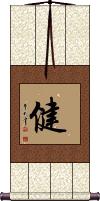
This “strong” character is the more “healthy” version of strong. 健 is the “strong” that is appropriate for an athlete.
Beyond “healthy,” it can also mean strength, persistence, vigorous, or invigorated/invigoration.
Vitality
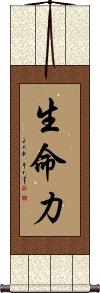
生命力 can mean “vitality” or “libido.”
The first two characters mean “life” or “life force.” The last character is a common word that means “strength.” So together, you get the meaning of “life strength” which is the essence of vitality.
Some will also translate this word as “good health.”
See Also: Life Force | Health
Strong Woman
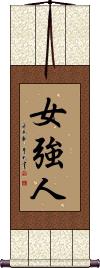
女強人 is the best way to say “strong woman” or “strong and independent woman” in Chinese.
Grammar in China is a bit different, so these three characters literally read as “female strength person” or “woman strong person.” This might sound funny in English, but this is a natural-sounding title in Chinese.
Strong / Healthy
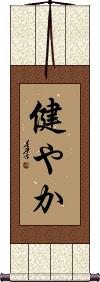
健やか is a verbose way to say strong and healthy in Japanese. 健やか is the “strong” that is appropriate for an athlete.
Beyond “healthy,” it can also mean strength, persistence, vigorous, or invigoration.
Japanese also use the first Kanji to mean the same thing. This version adds two hiragana which serve to emphasize or amplify the word and clarify the meaning.
Note: Because this selection contains some special Japanese Hiragana characters, it should be written by a Japanese calligrapher.
Strong / Powerful / Force
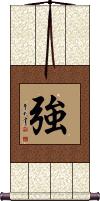
強 is a character that means strong, strength, force, powerful, better, stubborn, and stiff (yes, all of this in one character).
This “strong” has less to do with physical strength and more to do with having a winning attitude, or just having the ability to win at something.
Note that most of the time, this character is pronounced “qiang” but when used with the meaning of stubborn, unyielding, or stiff, it is pronounced “jiang” in Chinese.
Also, sometimes “qiang” is used in modern Chinese to describe people that do crazy things (For example: Bicycling from Beijing to Tibet alone). I sometimes can be found outside my Beijing apartment wearing nothing but shorts and a tee-shirt while eating ice cream during a snow storm, just to hear my neighbors call me “qiang.” Maybe they mean “strong” but perhaps they are using the new meaning of “crazy strong.”
強 can also be a Chinese surname that romanizes as Jiang in the mainland or Chiang if from Taiwan.
強 is a valid Korean Hanja character with the same meaning but is mostly used in compound Korean words.
強 is used in Japanese (though normally in compound words). In Japanese, it has the same meaning but in some contexts can mean “a little more than...” or “a little over [some amount].” Most Japanese would read this as tough, strength, stiff, hard, inflexible, obstinate, or stubborn.
The variant 彊 is sometimes seen in older literature.
Strong / Robust
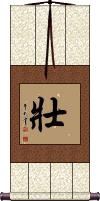
This “strong” character means “to strengthen” or robust. This brings images of a muscle-bound hulk of a weight lifter or bodybuilder to an Asian person who sees this character.
Note that in Korean and Japanese, this character is normally part of compound words, and is not seen alone too often.
Note that the this character was simplified in Japan after WWII (also simplified in mainland China but not for calligraphy). If you want the modern Japanese/simplified version, please click on the Kanji shown to the right.
Mighty / Powerful / Strong
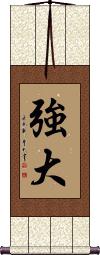
強大 can mean mighty, powerful, large, formidable, or strong.
This term is often used to describe soldiers/troops/warriors and whole armies.
Strong and Beautiful
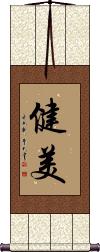
We don't really have a word like 健美 in English, but these two characters create a word that means “strong and beautiful.” It could also be translated as “healthy and beautiful.”
Note: 健美 is a word in Chinese and Korean, but it's also the family name Takemi in Japanese. The characters hold the same meaning in Japanese; however, it's like having the English name Stillwell when few people would perceive the meanings of still and well.
Perseverance / Fortitude
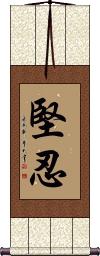
堅忍 means persistent, steadfast, fortitude, and/or perseverance.
The first character means strong, solid, firm, unyielding, or resolute.
The second character means to beat, endure, or tolerate.
Together they speak of the strength from within yourself. Some may also translate this as long-suffering in a more Biblical sense.
堅忍 is a common term in Chinese and Korean Hanja but a little less commonly used in modern Japanese Kanji. For that reason, this selection is best if your audience is Chinese or Korean.

 Note that when writing this as Kanji, Japanese will tend to write the second Kanji a little differently. If you select our Japanese master calligrapher, please expect the form where the little horizontal stroke crosses the vertical stroke. See differences in the images to the right. Technically, they are both the same character, and will be read the same in either language.
Perseverance / Indomitable / Invincible Fortitude

堅忍不抜 means determined, steadfast, unswerving, or unshakable in Japanese.
This is the Japanese version of an old Chinese 4-character perseverance proverb.
This would be understood in Chinese, but it's not commonly written this way in Chinese.
Note that when writing this as Kanji, Japanese calligraphers sometimes write the second Kanji in the form shown to the right. Yes,
it’s
just one stroke that is slightly different in location, crossing another stroke in this alternate Japanese Kanji form. If you have a preference, let us know when you order.
Due to some odd computer coding conventions, these two character forms were combined/merged into the same code point - thus, you will not see Kanji images of more Japanese form as you select options for your scroll.
Tempering Makes Strong Steel
Hardship Develops Strong Character
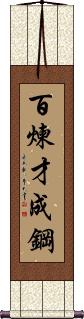
百煉才成鋼 / 百煉纔成鋼 literally translates as: Only after much tempering is steel produced.
Figuratively, this means: True character must be tested in hardship.
This is a mild form of saying, “Whatever doesn't kill me, makes me stronger.”
Will-Power / Self-Control
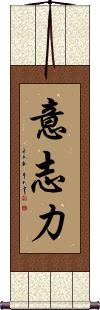
意志力 is a form of willpower or self-control and is about having the determination or tenacity to keep going.
In Japanese, this is the power of will, the strength of will, volition, intention, intent, or determination.
Perseverance / Will-Power
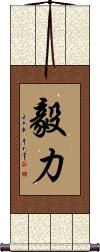
毅力 is a way to express “perseverance” with the idea of “willpower” in Chinese and old Korean Hanja. It can also mean “strong-willed.”
The first character means “strong” and “persistent,” while the second means “strength” and “power.”
Determination to Achieve / Will-Power
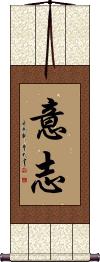
意志 is a Chinese, Korean, and Japanese word that means “determination to achieve.” It can also be translated as: will; willpower; determination; volition; intention; or intent.
In Japanese, this can also be the given name, Ishi.
Strong Hearted / Strong Willed
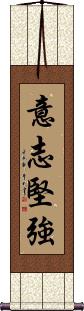
意志堅強 can mean either “strong-hearted,” “strong-willed” or “determination.”
The first two characters can be translated as “will,” “willpower,” “determination,” “volition,” “intention,” or “intent.” But, it should be noted that this first part possesses the element of “heart” in the lower portion of both characters (they also partially carry the meaning “with the whole heart”).
The last two characters mean “strong” or “staunch.”
Chinese word order and grammar are a bit different than English, so in this case, they are in reverse order of English but have the correct meaning in a natural form.
See Also: Strong Willed | Discipline | Will-Power
Perseverance
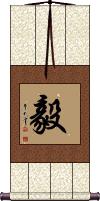
毅 is the simplest way to express perseverance in Chinese and Korean Hanja.
This single-character version leaves a bit of mystery about what kind of perseverance you might want to convey.
In Korean, this is usually associated with “strength of character.”
In Japanese, this character can be pronounced in a dozen different ways (so we have left out the Japanese pronunciation guide that normally appears above). In Japanese, this Kanji would usually be translated as “strong” (perhaps strong-willed).
Body and Earth in Unity
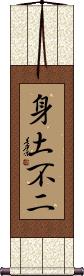
身土不二 (Shindofuni) is originally a Buddhist concept or proverb referring to the inseparability of body-mind and geographical circumstances.
This reads, “Body [and] earth [are] not two.”
Other translations or matching ideas include:
Body and land are one.
Body and earth can not be separated.
Body earth sensory curation.
You are what you eat.
Indivisibility of the body and the land (because the body is made from food and food is made from the land).
Going further, this speaks of our human bodies and the land from which we get our food being closely connected. This phrase is often used when talking about natural and organic vegetables coming directly from the farm to provide the healthiest foods in Japan.
Character notes: 身(shin) in this context does not just mean your physical body but a concept including both body and mind.
土 (do) refers to the soil, earth, clay, land, or in some cases, locality. It's not the proper name of Earth, the planet. However, it can refer to the land or realm we live in.
Japanese note: This has been used in Japan, on and off, since 1907 as a slogan for a governmental healthy eating campaign (usually pronounced as shindofuji instead of the original shindofuni in this context). It may have been hijacked from Buddhism for this propaganda purpose, but at least this is “healthy propaganda.”
Korean note: The phrase 身土不二 was in use by 1610 A.D. in Korea, where it can be found in an early medical journal.
In modern South Korea, it's written in Hangul as 신토불이. Korea used Chinese characters (same source as Japanese Kanji) as their only written standard form of the language until about a hundred years ago. Therefore, many Koreans will recognize this as a native phrase and concept.
See Also: Strength and Love in Unity
Healthy Living
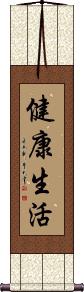
If you are into healthy living, 健康生活 might be an excellent selection for a wall scroll to hang in your home.
The first two characters speak of health, vitality, vigor, and being of sound body. The second two characters mean living or life (daily existence).
Undaunted After Repeated Setbacks
Persistence to overcome all challenges
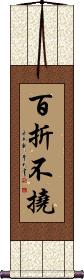
百折不撓 is a Chinese proverb that means “Be undaunted in the face of repeated setbacks.”
More directly translated, it reads, “[Overcome] a hundred setbacks, without flinching.” 百折不撓 is of Chinese origin but is commonly used in Japanese and somewhat in Korean (same characters, different pronunciation).
This proverb comes from a long, and occasionally tragic story of a man that lived sometime around 25-220 AD. His name was Qiao Xuan, and he never stooped to flattery but remained an upright person at all times. He fought to expose the corruption of higher-level government officials at great risk to himself.
Then when he was at a higher level in the Imperial Court, bandits were regularly capturing hostages and demanding ransoms. But when his own son was captured, he was so focused on his duty to the Emperor and the common good that he sent a platoon of soldiers to raid the bandits' hideout, and stop them once and for all even at the risk of his own son's life. While all of the bandits were arrested in the raid, they killed Qiao Xuan's son at first sight of the raiding soldiers.
Near the end of his career, a new Emperor came to power, and Qiao Xuan reported to him that one of his ministers was bullying the people and extorting money from them. The new Emperor refused to listen to Qiao Xuan and even promoted the corrupt Minister. Qiao Xuan was so disgusted that in protest, he resigned from his post as minister (something almost never done) and left for his home village.
His tombstone reads “Bai Zhe Bu Nao” which is now a proverb used in Chinese culture to describe a person of strong will who puts up stubborn resistance against great odds.
My Chinese-English dictionary defines these 4 characters as “keep on fighting despite all setbacks,” “be undaunted by repeated setbacks,” and “be indomitable.”
Our translator says it can mean “never give up” in modern Chinese.
Although the first two characters are translated correctly as “repeated setbacks,” the literal meaning is “100 setbacks” or “a rope that breaks 100 times.” The last two characters can mean “do not yield” or “do not give up.”
Most Chinese, Japanese, and Korean people will not take this absolutely literal meaning but will instead understand it as the title suggests above. If you want a single big word definition, it would be indefatigability, indomitableness, persistence, or unyielding.
See Also: Tenacity | Fortitude | Strength | Perseverance | Persistence
Creativity
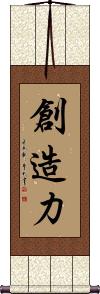
創造力 is a word that means “strength of creativity” or sort of “creativity (is your) strength.”
This can also be translated as “ingenuity.”
Creativity is the power of imagination. It is discovering your own special talents. Daring to see things in new ways and find different ways to solve problems. With your creativity, you can bring something new into the world.
The first character means “to create,” and the second means “to make or build.” Together they mean “creative.” The third character means “strength.”
Sincere / True Sincerity
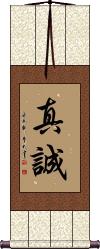
真誠 is the true essence of sincerity.
It takes strength of personality to be truly sincere without overdoing it. Speaking of strength, this is probably the strongest way to convey the idea of sincerity in the Chinese language.
The first character literally means true, real, and genuine. While the second character means sincere and honest.
Imagination
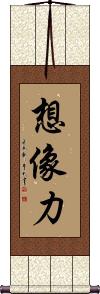
想像力 is probably the best way to express “imagination” in Chinese, Japanese Kanji, and old Korean Hanja.
It literally means “your strength to imagine.” The last character means strength or ability, while the first two mean imagine or conceptualize. My Japanese dictionary defines this as “The power of imagination.” While my Korean dictionary says, “imaginative power.”
No Pain No Gain
Literally: No Pain, No Strength
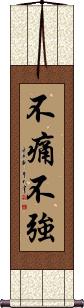
不痛不強 is a proverb that is close to our idea of “no pain, no gain” in English. It holds this meaning in the context of working out at the gym etc.
不痛不強 means “no pain, no strength,” meaning that if you don't experience a little pain, you will not gain any strength.
Intensity
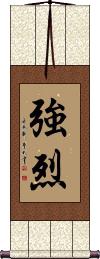
強烈 means intensity in regard to strength.
Note: In some contexts, this can mean violently strong or severe.
This is the most common transliteration to Mandarin Chinese for the masculine western name Lee.
力 means “power” or “strength.”
Note: This can sometimes be used as a male given name in China. It is not the only given name that sounds like Lee or Li in China.
Gutsy / Daring / Bold
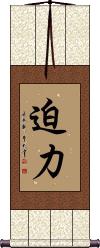
迫力 is a Chinese word that is a form of personal strength.
It is a word that describes a person who is willing to take a risk. In English, we might say, “Someone with guts.”
An example might be a person that is not rich but invests a lot of money into something (knowing they could double their money or lose it all). Win or lose, this is a person that knows or pushes their potential.
Tearing this word apart, the first character means “to compel,” urgent, urge, force, imminent, or “spur on.” The second means power, strong, bear, or exert.
Note: 迫力 is also a word in Japanese Kanji and Korean Hanja but with a meaning more like force, intensity, appeal, strength, impact, force, or simply power.
Potential / Momentum
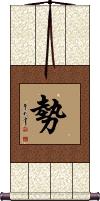
勢 is a word that means potential or momentum in Chinese, Japanese, and Korean.
Depending on the context, this can also be translated as an influence, tendency, military strength (potential), or power.
Great Power
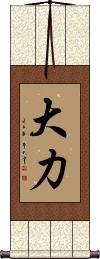
大力 can mean immense physical strength or great power.
This can also act as an adjective for expressing how energetically or vigorously something is.
This can also be a given name, Dairiki, in Japanese.
Mind Over Matter
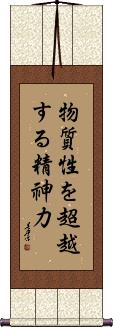
物質性を超越する精神力 means “mind over matter,” in Japanese.
If you get really technical, you get a translation like, “mental strength transcends materiality.”
Note: Because this selection contains some special Japanese Hiragana characters, it should be written by a Japanese calligrapher.
Daodejing / Tao Te Ching - Chapter 33
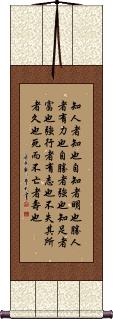
This is referred to as passage or chapter 33 of the Dao De Jing (often Romanized as “Tao Te Ching”).
These are the words of the philosopher Laozi (Lao Tzu).
To know others is wisdom;
To know oneself is acuity/intelligence.
To conquer others is power,
To conquer oneself is strength.
To know contentment is to have wealth.
To act resolutely is to have purpose.
To stay one's ground is to be enduring.
To die and yet not be forgotten is to be long-lived.
To understand others is to be knowledgeable;
To understand yourself is to be wise.
To conquer others is to have strength;
To conquer yourself is to be strong.
To know when you have enough is to be rich.
To go forward with strength is to have ambition.
To not lose your place is to be long-lasting.
To die but not be forgotten -- that's true long life.
He who is content is rich;
He who acts with persistence has will;
He who does not lose his roots will endure;
He who dies physically but preserves the Dao
will enjoy a long after-life.
Notes:
During our research, the Chinese characters shown here are probably the most accurate to the original text of Laozi. These were taken for the most part from the Mawangdui 1973 and Guodan 1993 manuscripts which pre-date other Daodejing texts by about 1000 years.
Grammar was a little different in Laozi’s time. So you should consider this to be the ancient Chinese version. Some have modernized this passage by adding, removing, or swapping articles and changing the grammar (we felt the oldest and most original version would be more desirable). You may find other versions printed in books or online - sometimes these modern texts are simply used to explain to Chinese people what the original text really means.
This language issue can be compared in English by thinking how the King James (known as the Authorized version in Great Britain) Bible from 1611 was written, and comparing it to modern English. Now imagine that the Daodejing was probably written around 403 BCE (2000 years before the King James Version of the Bible). To a Chinese person, the original Daodejing reads like text that is 3 times more detached compared to Shakespeare’s English is to our modern-day speech.
Extended notes:
While on this Biblical text comparison, it should be noted, that just like the Bible, all the original texts of the Daodejing were lost or destroyed long ago. Just as with the scripture used to create the Bible, various manuscripts exist, many with variations or copyist errors. Just as the earliest New Testament scripture (incomplete) is from 170 years after Christ, the earliest Daodejing manuscript (incomplete) is from 100-200 years after the death of Laozi.
The reason that the originals were lost probably has a lot to do with the first Qin Emperor. Upon taking power and unifying China, he ordered the burning and destruction of all books (scrolls/rolls) except those pertaining to Chinese medicine and a few other subjects. The surviving Daodejing manuscripts were either hidden on purpose or simply forgotten about. Some were not unearthed until as late as 1993.
We compared a lot of research by various archeologists and historians before deciding on this as the most accurate and correct version. But one must allow that it may not be perfect, or the actual and original as from the hand of Laozi himself.
Girl Power / Woman Power
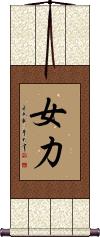
This can be read as “girl power,” “woman power,” “women empowerment” or “female strength.”
女力 is kind of a strange or unofficial title in Chinese and Japanese. At least, it's not common for a wall scroll.
This should be “onna ryoku” in Japanese but I found some who suggest it should be “me riki.”
Shitsujitsu Goken
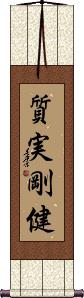
質実剛健 is a Japanese word that can mean “unaffected and sincere, with fortitude and vigor” or “simplicity and fortitude.”
The first two characters, 質実 mean simplicity or the “essence of something.”
The last two, 剛健, mean strength, fortitude, or strong composure.
Tenacious / Tenacity
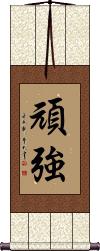
頑強 means “Tenacious,” “Hard to Defeat,” or “Dogged.”
Alone, the first character means mischievous, obstinate, or stubborn. But it loses some of the mischievous meaning when the second character is added.
The second character means strength, force, power, or better.
See Also: Determination | Dedication | Devotion | Never Give Up
Stay Strong / Iron Will
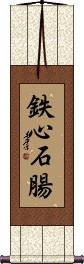
鉄心石腸 is a Japanese proverb that suggests you should have the inner-strength and will as hard and steadfast as iron.
It's the Japanese way of saying, “stay strong.” This is an especially uplifting thing to say to a person in distress or recovering from a disaster. It's kind of the survivor's creed.
If you literally translate this, it means “iron will, stone guts” or “iron heart, rock-hard bowels.”
Carry On, Undaunted
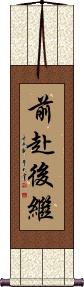
前赴後繼 is a Chinese proverb that figuratively means “to advance dauntlessly in wave upon wave.”
It suggests that you should or can carry on and have the strength to keep going.
While this proverb is a little bit militaristic, it suggests that despite a fallen comrade (or perhaps a loved one), you should keep going and work towards the goal they intended.
Resilience / Restoration / Recovery
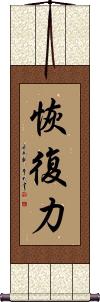
恢復力 suggests having the power to recover, restore, and rehabilitate. This can refer to yourself, someone else, or even to something, like rehabilitating a burned forest. 恢復力 is the essence of resilience in life.
The first two characters are a word that means to reinstate, resume, restore, recover, regain, or rehabilitate, restoration, rehabilitation, recovery, return, improvement, recovery (from an illness), recuperation, or convalescence.
The last character means strength or power.
See Also: Tenacity | Perseverance
Know Thy Enemy, Know Thyself
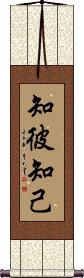
This proverb is from Sun Tzu's (Sunzi's) Art of War.
It means that if you know and understand the enemy, you also know yourself. Four secondary characters come after this in the Art of War (not included here) which suggests you cannot lose a battle when you follow this philosophy.
In a very literal and somewhat-boring way, this can also be translated as “Estimate correctly one's strength as well as that of one's opponent.”
Cooperation
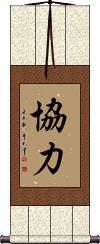
協力 is a Japanese word that means cooperation.
If you look at the second character, which means “strength” or “power,” and then you look at the first character, you will see that the first character seems to represent multiple “strengths” together. Thus, you can visually see the meaning of this word as “stronger when working together.” The combination of characters that form this word is commonly seen in Japanese Kanji and Korean Hanja but not used in China (however, a Chinese person could probably guess the meaning, and it can be pronounced in Chinese).
It is implied that you are cooperating to create some project or product.
This can also be translated as “joint effort.”
See Also: Partnership
Dragon
Year of the Dragon / Zodiac Sign
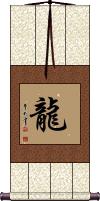
龍 is the character for dragon in Chinese, old Korean Hanja, and Japanese Kanji.
The dragon is a creature of myth and legend that dominates Chinese, Japanese, and even European folklore. In China, the dragon is the symbol of the Emperor, strength, and power, and the Chinese dragon is known as the god of water.
From the Chinese Zodiac, if you were born in the year of the Dragon, you . . .
Have a strong body and spirit.
Are full of energy.
Have vast goals.
Have a deep level of self-awareness.
Will do whatever you can to “save face.”
See also our Chinese Zodiac or Dragon Calligraphy pages.
Hapkido
Korean Martial Art of re-directing force
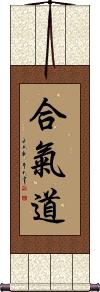
Hapkido or 合氣道 is a mostly-defensive martial art in Korea.
Hapkido has some connection to the Aikido of Japan. They are written with the same characters in both languages. However, it should be noted that the Korean Hanja characters shown here are the traditional Chinese form - but in modern Japan, the middle character was slightly simplified.
Note: You can consider this to be the older Japanese written form of Aikido. Titles on older books and signs about Aikido use this form.
The connection between Japanese Aikido and Korean Hapkido is muddled in history. The issue is probably due to the difficult relationship between the two countries around WWII. Many Koreans became virtual slaves to the Japanese during that period. After WWII, many things in Korea were disassociated from having any Japanese origin. The relationship has greatly mellowed out now.
Looking at the characters, the first means “union” or “harmony.”
The second character means “universal energy” or “spirit.”
The third means “way” or “method.”
One way to translate this into English is the “Harmonizing Energy Method.” This makes sense, as Hapkido has more to do with redirecting energy than fighting strength against strength.
More Hapkido info
More notes:
1. Sometimes Hapkido is Romanized as “hap ki do,” “hapki-do” “hab gi do” or “hapgido.”
2. Korean Hanja characters are actually Chinese characters that usually hold the same meaning in both languages. There was a time when these characters were the standard and only written form of Korean. The development of modern Korean Hangul characters is a somewhat recent event in the greater scope of history. There was a time when Chinese characters were the written form of many languages in places known in modern times as North Korea, South Korea, Japan, Vietnam, Singapore, Hong Kong, Taiwan, Mainland China, and a significant portion of Malaysia. Even today, more people in the world can read Chinese characters than English.
3. While these Korean Hanja characters can be pronounced in Chinese, this word is not well-known in China and is not considered part of the Chinese lexicon.
Tai Chi Chuan / Tai Ji Quan
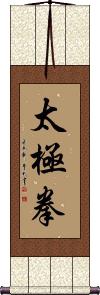
太極拳 is the famous Taoist meditation and martial art exercise. The direct translation of these characters would be something like “grand ultimate fist,” but that does not quite hit the mark for what this title really means.
An early-morning walk through any city in China near a park or an open area will yield a view of Chinese people practicing this ancient technique.
A typical scene is an old man of no less than 80 years on this earth, with a wispy white beard and perhaps a sword in one hand. He makes slow moves that are impossibly smooth. He is steady-footed and always in balance. For him, time is meaningless and proper form, and technique is far more important than speed.
For the younger generation, faster moves may look impressive and seem smooth to the casual observer. But more discipline and mental strength are needed to create perfectly smooth moves in virtual slow motion.
Note: There are two ways to Romanize these Chinese characters, as seen in the title above. The pronunciation and actual characters are the same in Chinese. If you really used English sounds/words to pronounce this, it would be something like “tie jee chew-on” (make the “chew-on” one flowing syllable).
Fatal error: Cannot redeclare foreignPrice() (previously declared in /home/gwest/web/chinesescrollpainting.com/public_html/includes/currencyconverter.php:22) in /home/gwest/web/orientaloutpost.com/public_html/includes/currencyconverter.php on line 22