Many custom options...


And formats...



Success in Chinese / Japanese...
Buy a Success calligraphy wall scroll here!
Personalize your custom “Success” project by clicking the button next to your favorite “Success” title below...
1. Success
2. Failure is the Origin of Success
3. Failure is a Stepping Stone to Success
4. Failure is the Mother of Success
5. Dream Come True / Enjoy Success
6. Any success can not compensate for failure in the home
7. Realize Your Ambitions / Ride on the Crest of Success
Success
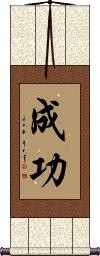
This Chinese and Japanese word for “success” is often used to refer to “career success” but is also used for other successes in life.
It matches the western dictionary definition of “The achievement of something desired, planned, or attempted.” And It's also used in this old Chinese proverb:  which means Failure is the Mother of Success.
Sometimes this word is translated as prosperity, but success, succeed, or successfully are more correct definitions.
See Also: Prosperity
Failure is the Origin of Success
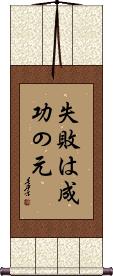
This Japanese proverb reads, “failure/mistake/blunder/defeat is the origin of success.”
It suggests that failures or defeats are a necessary part of success.
失敗は成功の元 is often translated as “Failure is a stepping stone to success.”
Note: There are a few similar variations of this idiom in Japanese.
Note: Because this selection contains some special Japanese Hiragana characters, it should be written by a Japanese calligrapher.
See Also: Failure is a Stepping Stone to Success
Failure is a Stepping Stone to Success
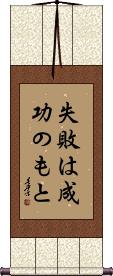
This Japanese proverb literally reads, “failures/mistakes/blunders are the yeast-starter/yeast-mash of success.”
Basically, it suggests that failures are a necessary part of success; Just as bread or beer requires yeast to successfully rise or brew/ferment.
Note: Because this selection contains some special Japanese Hiragana characters, it should be written by a Japanese calligrapher.
Failure is the Mother of Success
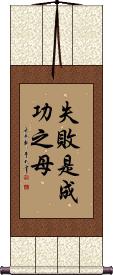
失败是成功之母 is a Chinese and Korean proverb that means “Every failure that you experience is a chance to learn from it and find success.”
Knowing what does not work is just as important as finding out what does work.
See Also: Experience is the Mother of Wisdom
Failure is the Mother of Success
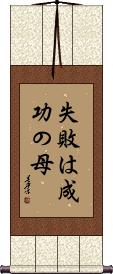
失敗は成功の母 is a Japanese proverb that means exactly what you think.
Every failure that you experience is a chance to learn from it and find success.
Knowing what does not work is just as important as finding out what does work.
Note: This is the Japanese version of an ancient Chinese proverb.
Note: Because this selection contains some special Japanese Hiragana characters, it should be written by a Japanese calligrapher.
See Also: Experience is the Mother of Wisdom
Dream Come True / Enjoy Success
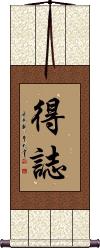
得誌 is a Chinese word that means to accomplish one's ambition, a dream come true, or to enjoy your success.
Any success can not compensate for failure in the home
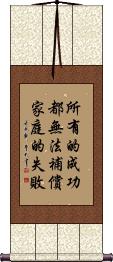
所有的成功都無法補償家庭的失敗 is a Chinese proverb that can be translated into English as “No success can compensate for failure in the home.”
Also, the word “home” can be exchanged with “family.”
Realize Your Ambitions / Ride on the Crest of Success
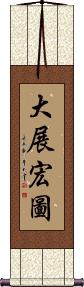
大展宏圖 is a four-character proverb used in Chinese to mean “realize your ambitions” or “exhibit your ambition and success.”
It's used to talk about someone with great career ambitions. Almost literally, it expresses the idea of someone unfolding a great career like a map or a set of blueprint plans.
Very literally translated, these four characters mean “Great unfolding of a huge map” or “Great exhibition of a colossal plan.”
Do not fear the task: Cooperation will lead to success
Do not fear strong winds waves; just be sure to row in unison
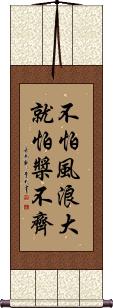
不怕风浪大就怕桨不齐 is a Chinese proverb that literally translates as: Do not fear strong winds [and] high waves; what [one should] worry about whether or not you're rowing in unison.
Figuratively, this means: However difficult the task, the key to success lies in making collective efforts.
I like to translate this as “Don't sweat the details, just get together and get it done.”
Even a fool may sometimes come up with a good idea
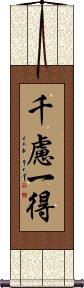
千慮一得 means “1000 tries, one success,” or “[a] thousand tries [leads to] one success.”
This proverb is a humble way to express your success, ideas, or accomplishments. As if you are a fool who just got lucky in inventing or creating something.
Translations for this proverb include:
Even without any notable ability on my part, I may still get it right sometimes by good luck.
Even a fool may sometimes come up with a good idea.
Compare this to the English idiom, “Even a broken clock is right twice a day.”
Fatal error: Cannot redeclare function foreignPrice() (previously declared in /home/gwest/web/chinesescrollpainting.com/public_html/includes/currencyconverter.php:22) in /home/gwest/web/orientaloutpost.com/public_html/includes/currencyconverter.php on line 22