Wisdom Chinese & Japanese Calligraphy Wall Scrolls
You need a Wisdom Wall Scroll?
We'll build a quality custom Wisdom wall scroll for you at a discount price!
1. Wisdom
2. Wisdom comes from Experience
4. The Five Tenets of Confucius
5. Justice / Rectitude / Right Decision
Wisdom
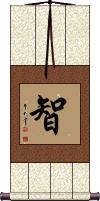
智 is the simplest way to write wisdom in Chinese, Korean Hanja, and Japanese Kanji.
Being a single character, the wisdom meaning is open to interpretation, and can also mean intellect, knowledge or reason, resourcefulness, or wit.
智 is also one of the five tenets of Confucius.
智 is sometimes included in the Bushido code but is usually not considered part of the seven key concepts of the code.
See our Wisdom in Chinese, Japanese and Korean page for more wisdom-related calligraphy.
See Also: Learn From Wisdom | Confucius
Wisdom comes from Experience
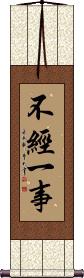
不經一事 means “You can't gain knowledge without practical experience.”
This is the short form (first half) of a longer Chinese proverb. These 4 characters remind you that wisdom only comes from experience.
Intelligence / Intellect
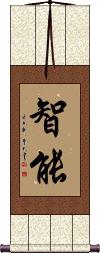
These two characters mean intelligence or intelligent.
The first character means wisdom, intellect, or knowledge.
The second means ability, talent, skill, capacity, capable, able, and can even mean competent.
Together, 知能 can mean “capacity for wisdom,” “useful knowledge,” or even “mental power.” Obviously, this translates more clearly into English as “intelligence.”
Note: This is not the same word used to mean “military intelligence.” See our other entry for that.
 In modern Japan, they tend to use a version of the first character without the bottom radical. If your audience for this artwork is Japanese, please click on the Kanji to the right instead of the button above.
The Five Tenets of Confucius
The Five Cardinal Rules / Virtues of Confucius
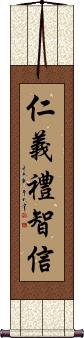
仁義禮智信 are the core of Confucius's philosophy.
Simply stated:
仁 = Benevolence / Charity
義 = Justice / Rectitude
禮 = Courtesy / Politeness / Tact
智 = Wisdom / Knowledge
信 = Fidelity / Trust / Sincerity
Many of these concepts can be found in various religious teachings. It should be clearly understood that Confucianism is not a religion but should instead be considered a moral code for a proper and civilized society.
This title is also labeled “5 Confucian virtues.”
 If you order this from the Japanese calligrapher, expect the middle Kanji to be written in a more simple form (as seen to the right). This can also be romanized as "jin gi rei satoshi shin" in Japanese. Not all Japanese will recognize this as Confucian tenets but they will know all the meanings of the characters.
See Also: Confucius Teachings | Ethics
Justice / Rectitude / Right Decision
Also means: honor loyalty morality righteousness
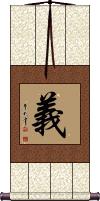
義 is about doing the right thing or making the right decision, not because it's easy but because it's ethically and morally correct.
No matter the outcome or result, one does not lose face if tempering proper justice.
義 can also be defined as righteousness, justice, morality, honor, or “right conduct.” In a more expanded definition, it can mean loyalty to friends, loyalty to the public good, or patriotism. This idea of loyalty and friendship comes from the fact that you will treat those you are loyal to with morality and justice.
義 is also one of the five tenets of Confucius's doctrine.
 There's also an alternate version of this character sometimes seen in Bushido or Korean Taekwondo tenets. It's just the addition of a radical on the left side of the character. If you want this version, click on the image to the right instead of the button above.
This is also a virtue of the Samurai Warrior
See our page with just Code of the Samurai / Bushido here
See Also: Judgment | Impartial | Confucius Tenets
All Tenets of the Noble Eightfold Path
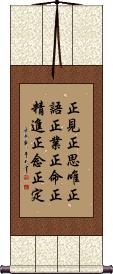
These are the eight tenets of the Buddhist Noble Eightfold Path written altogether.
Here's this list of tenets in English:
1. Right View / Right Understanding / Right Perspective / Perfect View
2. Right Resolve / Right Thought / Right Intention / Perfect Resolve
3. Right Speech / Right Talk / Perfect Speech
4. Right Action / Perfect Conduct
5. Right Living / Right Livelihood / Perfect Livelihood
6. Right Effort / Right Endeavor / Perfect Effort
7. Right Mindfulness / Right Memory / Perfect Mindfulness
8. Right Concentration / Perfect Concentration
Tang Soo Do Tenets
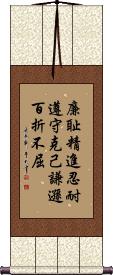
廉耻精進忍耐遵守克己謙遜百折不屈 are the tenets of Tang Soo Do.
| English | Old Hanja | Modern Hangul | Pronunciation |
| 1. Integrity | 廉耻 | 렴치 or 염치 | yeom ci |
| 2. Concentration | 精進 | 정진 | jeong jin |
| 3. Perseverance | 忍耐 | 인내 | in nae |
| 4. Respect & Obedience | 遵守 | 준수 | jun su |
| 5. Self-Control | 克己 | 극기 | geug gi |
| 6. Humility | 謙遜 | 겸손 | gyeom son |
| 7. Indomitable Spirit | 百折不屈 | 백절불굴 | baeg jeor bur gur |
After some research, it appears this list was compiled in English based on Taekwondo tenets. We filled in a few of the words that did not have a corresponding Hanja or Hangul. If someone else has a better list with characters included, please contact me.
Taekwondo Tenets / Spirit of Taekwon-do
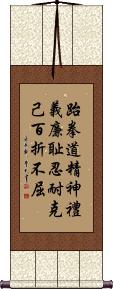
跆拳道精神禮義廉耻忍耐克己百折不屈 is General Choi's writing that is often called “The Tenets of Taekwon-do.”

The actual title would be translated as “Taekwondo Spirit” or “The Spirit of Taekwondo.” It was originally written in Korean Hanja (Chinese characters used in Korea for about 1600 years).
General Choi's original calligraphy is shown to the right. Your custom calligraphy will be unique, and not an exact match, as each calligrapher has their own style.In modern times, the common form of written Korean is Hangul (a phonetic character set). The table below shows the text in Hangul and Hanja along with a pronunciation guide and a brief English translation:
| Traditional Korean Hanja | Modern Korean Hangul | Pronunciation | English |
| 跆拳道精神 | 태권도정신 | tae gweon do jeong sin | Taekwondo Spirit |
| 禮儀 | 예의 | ye yi | Courtesy / Etiquette / Propriety / Decorum / Formality |
| 廉耻 | 염치 | yeom ci | Integrity / Sense of Honor |
| 忍耐 | 인내 | in nae | Patience / Perseverance / Endurance |
| 克己 | 극기 | geug gi | Self-Control / Self-Denial / Self-Abnegation |
| 百折不屈 | 백절불굴 | baeg jeor bur gur | Indomitable Spirit (Undaunted even after repeated attacks from the opponent) |
| Note that the pronunciation is the official version now used in South Korea. However, it is different than what you may be used to. For instance, “Taekwon-do” is “tae gweon do.” This new romanization is supposed to be closer to actual Korean pronunciation. | |||
Fatal error: Cannot redeclare foreignPrice() (previously declared in /home/gwest/web/chinesescrollpainting.com/public_html/includes/currencyconverter.php:22) in /home/gwest/web/orientaloutpost.com/public_html/includes/currencyconverter.php on line 22